











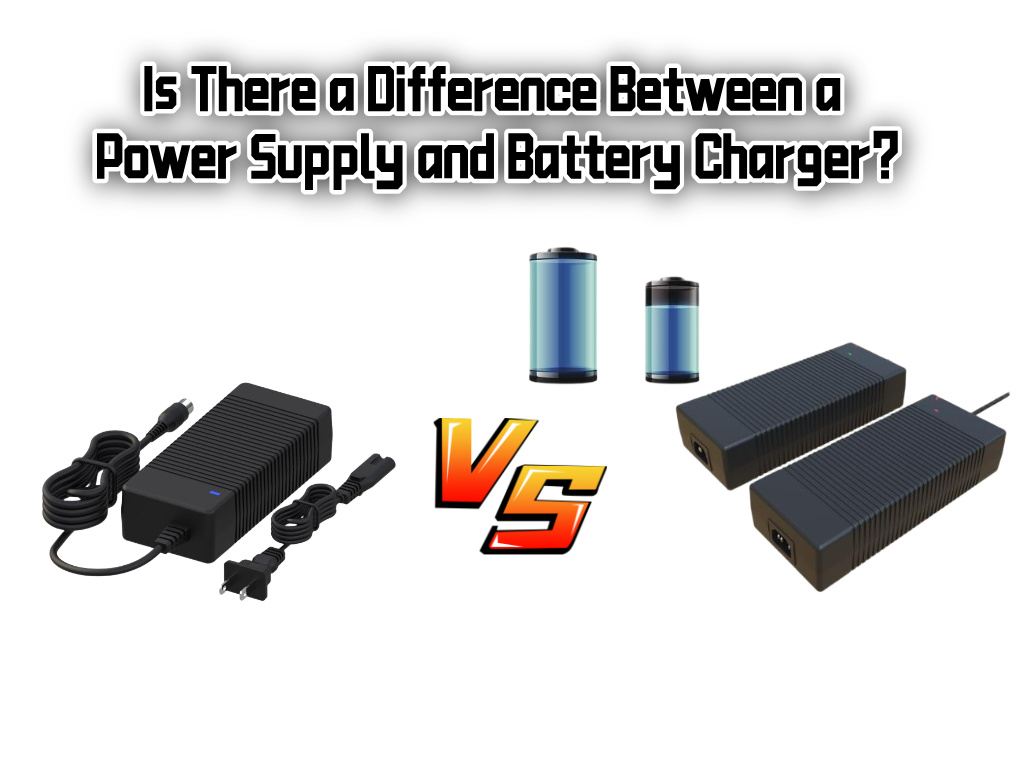
電源供應器和電池充電器有什麼不同嗎?
Key Distinctions Explained
In the world of power electronics, the terms “power supply” and “battery charger” are often used interchangeably, leading to confusion and potential equipment damage. While both devices deliver electrical power, they serve fundamentally different purposes with distinct operating characteristics.
Understanding the Core Functions
Power Supply: The Voltage Regulator
A power supply is designed to provide a stable, constant output voltage regardless of changes in the connected load or input fluctuations. Its primary job is to convert available power (typically AC mains) to a specific DC voltage level that remains consistent as long as the power supply operates within its rated specifications.
Key characteristics:
- Maintains constant output voltage
- Output current varies based on load demand
- Typically lacks specialized charging algorithms
- May not prevent battery overcharging
電池充電器: The Intelligent Energy Manager
A battery charger is specifically engineered to recharge battery systems safely and efficiently. Unlike simple power supplies, chargers incorporate charging algorithms that vary voltage and current throughout the charging cycle to optimize battery health, capacity, and lifespan.
Key characteristics:
- Implements multi-stage charging profiles (bulk, absorption, float)
- Adjusts output based on battery state and chemistry
- Includes safety features to prevent overcharging
- May condition batteries through maintenance cycles
Technical Differences in Operation
Charging Profiles and Battery Chemistry
The most significant distinction lies in how each device responds to the battery being charged:
Power Supply Behavior:
- Delivers constant voltage (e.g., 13.8V for a 12V system)
- Current decreases as battery voltage approaches supply voltage
- No automatic shutoff when battery is fully charged
- Can overcharge batteries if left connected indefinitely
Battery Charger Behavior:
- Bulk Stage: Delivers constant current until battery reaches ~80% capacity
- Absorption Stage: Holds constant voltage while current tapers
- Float Stage: Reduces voltage to maintenance level for long-term storage
- Equalization: Periodic overcharge to balance cells (for certain chemistries)
Voltage Regulation vs. Charge Management
Standard power supplies use basic voltage regulation circuits, while battery chargers incorporate microprocessors that:
- Monitor battery voltage and temperature
- Adjust charge parameters for specific battery types (lead-acid, Li-ion, NiMH)
- Compensate for temperature variations
- Detect faulty batteries and terminate charging
The Compatibility Question: Can They Be Interchanged?
Using a 電源供應器 as a Battery Charger
In emergency situations, a power supply with voltage adjustment capability can charge batteries if:
- Voltage is set appropriately for the battery chemistry and state of charge
- Current is limited to safe levels (typically 10-30% of battery capacity)
- The battery is manually disconnected when fully charged
- Temperature is monitored to prevent overheating
Risks include:
- Reduced battery capacity and lifespan
- Overcharging and electrolyte loss (in flooded batteries)
- Thermal runaway with lithium batteries
- Voided battery warranties
Using a Battery Charger as a Power Supply
Most modern battery chargers with “power supply mode” or “float maintenance” can safely power DC loads. However:
- Loads must remain within the charger’s current rating
- Some chargers may misinterpret loads as battery faults
- Output may be less stable than a dedicated power supply
- Efficiency may be lower than purpose-built power supplies
Application-Specific Considerations
When to Use a Power Supply:
- Powering electronic devices directly (LED lighting, amplifiers, radios)
- Laboratory bench testing and prototyping
- Fixed voltage applications without battery storage
- Industrial control systems with stable loads
When to Use a Battery Charger:
- Recharging automotive, marine, or RV batteries
- Maintaining standby power systems (UPS, emergency lighting)
- Solar energy storage systems
- Portable device charging (phones, laptops, power tools)
Dual-Function Devices
Many modern units bridge this gap by offering:
- Smart power supplies with basic charging capabilities
- Laboratory power supplies with constant current modes
- Advanced chargers with regulated power supply modes
Key Safety Implications
Critical Safety Features in Battery Chargers:
- Automatic voltage cutoff prevents overcharging
- Reverse polarity protection protects against incorrect connections
- Short circuit protection shuts down output during faults
- Temperature compensation adjusts voltage based on battery temperature
- Spark suppression prevents explosions in gassy environments
Missing from Most Basic Power Supplies:
- Overcharge prevention
- Battery condition monitoring
- Chemistry-specific charging algorithms
- Automatic maintenance cycling
Cost and Complexity Factors
While basic power supplies are generally less expensive than battery chargers with equivalent current ratings, the price difference reflects:
- Added microprocessor control in chargers
- Advanced charging algorithms
- Additional safety features
- Brand reputation and warranty considerations
For occasional battery charging, a basic power supply with careful monitoring may suffice. For regular battery maintenance or critical applications, a dedicated charger represents a worthwhile investment in battery longevity and safety.
Making the Right Choice: Decision Guidelines
Ask these questions before selecting:
- Primary purpose: Am I mainly powering devices or charging batteries?
- Battery chemistry: What type of battery am I working with?
- Usage frequency: Will this be occasional or regular use?
- Safety requirements: Is the application in a hazardous environment?
- Battery value: Is the battery expensive enough to justify protection?
The Bottom Line
While power supplies and battery chargers may appear similar externally, their internal design and operational logic differ significantly. Power supplies regulate voltage; battery chargers manage energy transfer into electrochemical storage systems.
Using the wrong device can lead to:
- Reduced battery performance and lifespan
- Safety hazards including fire risk
- Equipment damage
- Voided warranties
For optimal results and safety, use:
- Dedicated battery chargers for all regular charging applications
- Quality power supplies for direct device power needs
- Combo units only when they explicitly support both functions
Investing in the right tool for the job protects both your equipment and your safety, while ensuring optimal performance from your power systems and batteries.
Still unsure which solution fits your needs? Consider your specific application, battery type, and safety requirements. When in doubt, consult with an electrical professional or equipment manufacturer to ensure compatibility and safety.

關於作者









新增評論