











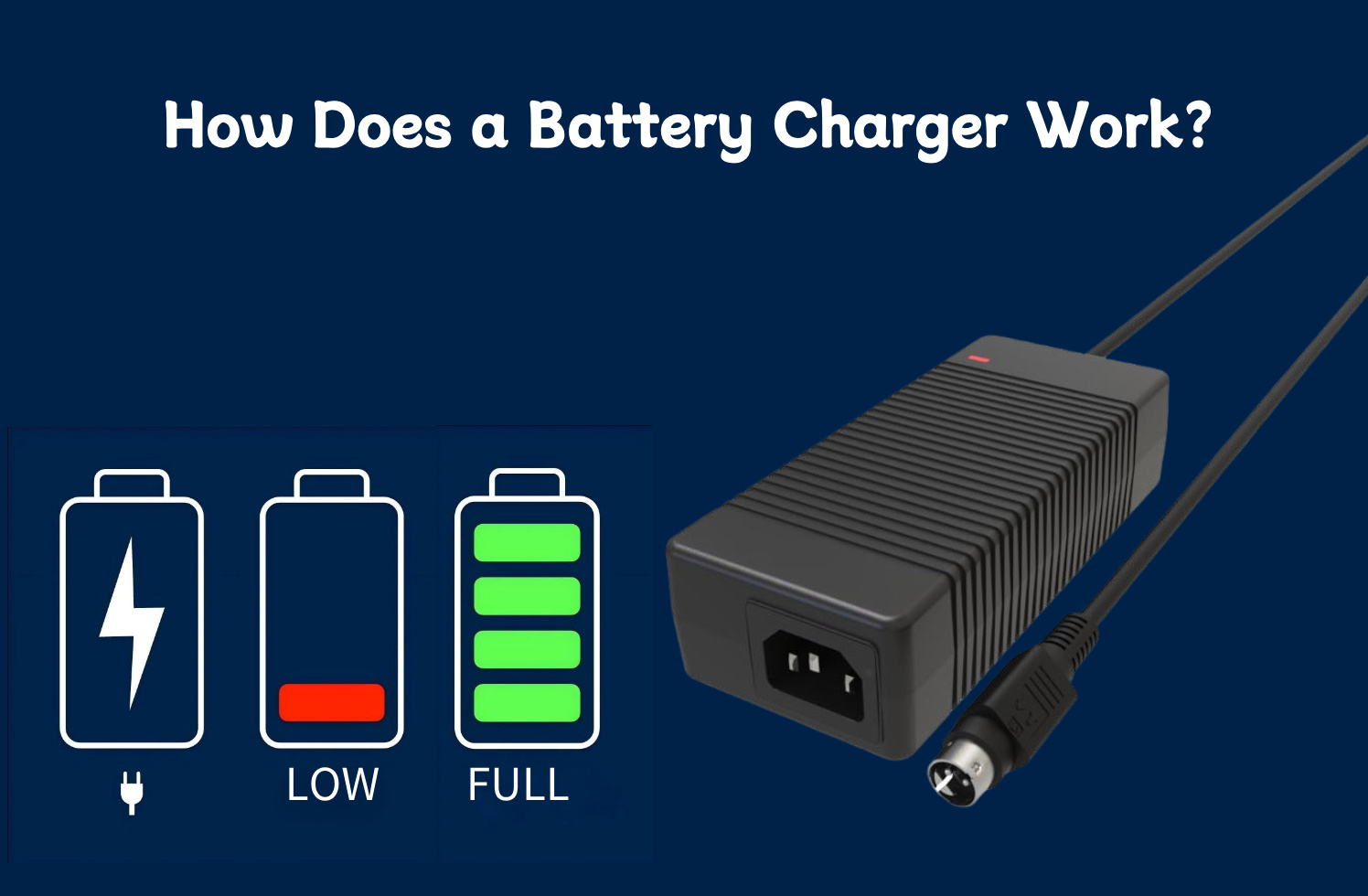
How Does a Battery Charger Work?
At first glance, a battery charger seems simple: plug it in, and it fills your battery with power. But the process happening inside that small box or circuit is a carefully orchestrated sequence of electrical conversion, intelligent management, and precise control. Understanding how it works helps you choose better chargers, extend battery life, and use your devices more safely.
This article breaks down the fundamental principles behind how battery chargers transform wall power into safe, storable energy for your devices.
The Core Mission: Convert and Control
A battery charger has two primary jobs:
- Convert the available power source (usually high-voltage Alternating Current from a wall outlet) into a form the battery can use (lower-voltage Direct Current).
- Control the flow of this power intelligently to charge the battery efficiently, completely, and without causing damage.
Let’s follow this journey step-by-step.
Step 1: AC to DC Conversion – The Foundation
Input: Wall Outlet AC (e.g., 120V/230V, 50/60Hz)
Goal: Convert to smoother, lower-voltage DC.
This is achieved through several stages in the charger’s power supply:
- Rectification: The charger first passes the AC through a rectifier (a set of diodes). This component acts as a one-way valve for electricity, cutting off the negative half of the AC wave, resulting in a pulsating positive voltage.
- Filtering: This rough, pulsating DC is then smoothed out by passing through capacitors. They store and release charge, filling in the “gaps” to create a much more stable DC voltage.
- Voltage Regulation & Reduction: The high DC voltage (still near peak wall voltage) must be stepped down to a level suitable for the battery. This is done by a complex circuit called a switch-mode power supply (SMPS). An SMPS rapidly switches the power on and off and uses a small transformer and other components to efficiently reduce the voltage to the precise level needed (e.g., 12V, 5V, 4.2V).
Output of this stage: A clean, stable, low-voltage Direct Current ready for the battery.
Step 2: The Intelligent Charge – CC/CV Algorithm
Simply connecting a stable DC source to a battery is dangerous and inefficient. This is where the charger’s “brain” takes over. For lithium-ion (Li-ion) and most modern batteries, the standard is the Constant Current / Constant Voltage (CC/CV) charging method.
Phase 1: Constant Current (CC) – The Bulk Charge
- When the battery is at a low state of charge, the charger applies a constant, controlled current (e.g., 1 Amp, 2 Amps).
- During this phase, the battery’s voltage steadily rises as it absorbs energy. This is the fastest part of the charging cycle, replenishing about 60-80% of the battery’s capacity.
- Think of it like filling a glass with water from a steady, controlled stream.
Phase 2: Constant Voltage (CV) – The Absorption/Taper Charge
- Once the battery voltage reaches its peak design voltage (e.g., 4.20V for a standard Li-ion cell), the charger switches modes.
- It now holds the voltage constant at that peak level.
- As the battery becomes nearly full, its resistance increases. To maintain the constant voltage, the charger automatically and gradually reduces (tapers) the current flowing in.
- Charging typically terminates when the current tapers down to a very small trickle (e.g., 3-10% of the initial constant current).
- Think of this as carefully topping off the glass to the brim, slowing the flow to avoid overflow.
(A simplified graph of the CC/CV charging process for a single Li-ion cell.)
Safety & Communication: Throughout this process, a quality charger constantly monitors parameters like temperature and time. It communicates with the battery’s own Battery Management System (BMS) when possible, and will pause or stop charging if it detects a fault, overheating, or a dangerous condition.
Specialized Chargers & Features
While the CC/CV principle is universal, different applications add layers of complexity:
- Multi-Cell Pack Chargers (for e-bikes, tools): These must perform balance charging. They use a separate wire harness to monitor and gently equalize the voltage of each individual cell in the pack, preventing dangerous imbalances.
- Fast Chargers: They operate on the same CC/CV principle but use higher current during the CC phase. This requires robust electronics, advanced thermal management, and a direct communication protocol (like USB Power Delivery or Qualcomm Quick Charge) between the charger and device to negotiate a safe, higher power level.
- “Smart” or “Maintenance” Chargers: For lead-acid or seasonal equipment, these include additional stages like a float or trickle charge to keep a battery at 100% without overcharging, and a desulfation mode to recover aged batteries.
- Wireless Chargers: They replace the physical wire with two coils of wire (one in the charger, one in the device). The charger’s coil creates an oscillating magnetic field with AC, which induces an AC current in the device’s coil. This AC is then rectified and regulated inside the device back into DC to charge the battery via a standard CC/CV circuit.
The Critical Role of the Battery Management System (BMS)
It’s important to distinguish the charger from the BMS, which is a circuit built into the battery pack itself. They work as a team:
- 的 charger is the “smart power source” that delivers controlled energy.
- 的 BMS is the “battery’s guardian.” It monitors cell voltages, temperature, and current, protects against over-discharge, and in advanced systems, communicates directly with the charger to optimize the cycle.
Conclusion: More Than Just a Power Adapter
A battery charger is a sophisticated piece of electronics. It’s a transformer, a regulator, and an intelligent controller all in one. By converting AC to DC and meticulously managing the charge cycle through the CC/CV algorithm, it ensures our batteries are replenished safely, efficiently, and ready to power our lives.
Key Takeaway: When you choose a charger, you’re not just buying a power cable. You’re investing in the logic board that determines how well—and how long—your expensive battery will perform. Always use a charger designed for your battery’s specific voltage and chemistry to ensure this intricate process happens as intended.


關於作者











新增評論