











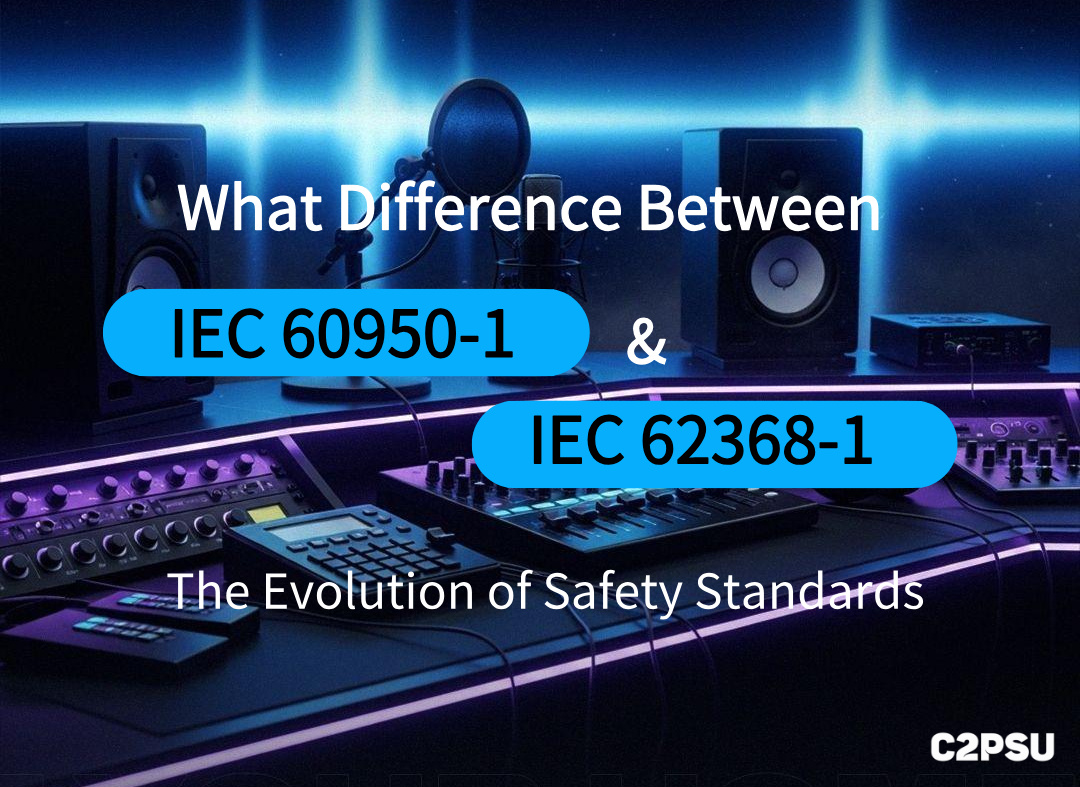
Difference Between IEC 60950-1 and IEC 62368-1: The Evolution of Safety Standards
Executive Summary
IEC 60950-1 (Information Technology Equipment Safety) and IEC 62368-1 (Audio/Video, Information and Communication Technology Equipment) represent two generations of safety standards with fundamentally different approaches. While IEC 60950-1 was the long-standing standard for IT equipment, IEC 62368-1 is now the mandatory replacement that takes a more comprehensive, hazard-based approach to product safety.
Key Timeline and Transition
- IEC 60950-1: Published in 1999, with multiple amendments through 2014
- IEC 62368-1: First published in 2010, with current 3rd edition (2018) being mandatory
- Transition Deadline: Most regions completed transition by December 2020
- Current Status: IEC 60950-1 is officially withdrawn and replaced globally
Fundamental Philosophical Differences
IEC 60950-1: Prescriptive “Rules-Based” Approach
- Methodology: Traditional, prescriptive requirements
- Focus: Specific safeguards against known hazards
- Structure: Detailed “how-to” instructions for compliance
- Limitation: Reactive to existing technologies rather than anticipating new ones
IEC 62368-1: Modern “Hazard-Based” Approach
- Methodology: Hazard-based safety engineering (HBSE)
- Focus: Identifying energy sources and preventing injury
- Structure: Principles-based framework adaptable to new technologies
- Advantage: Proactive, technology-agnostic, and future-proof
Three Energy Source Classes (IEC 62368-1)
The new standard categorizes potential hazards into three classes:
- Class 1 Energy Sources
- Not likely to cause pain or injury
- Example: Low-voltage circuits (< 30V RMS, < 42.4V peak)
- Class 2 Energy Sources
- May cause discomfort but not injury
- Example: Higher voltage but limited energy circuits
- Class 3 Energy Sources
- Likely to cause injury
- Example: Mains power, high-voltage batteries
Key Technical Differences
1. Fire Prevention Requirements
- IEC 60950: Uses detailed construction requirements for fire enclosures
- IEC 62368: Implements “Power Source” classification with defined limits
- Impact: More flexibility in material selection while maintaining safety
2. Electrical Safety Requirements
- IEC 60950: Specific spacing requirements (creepage/clearance)
- IEC 62368: Maintains similar spacing but ties them to overvoltage categories
- Improvement: Better correlation between insulation and actual working conditions
3. Battery Safety
- IEC 60950: Limited battery safety requirements
- IEC 62368: Comprehensive battery safety, including cell, battery pack, and system levels
- Significance: Critical for modern portable and wireless devices
4. Audio/Video Equipment Inclusion
- IEC 60950: Primarily IT equipment
- IEC 62368: Combines scope of IEC 60950 and IEC 60065 (AV equipment)
- Benefit: Single standard for converged technologies
Testing and Certification Differences
Documentation Requirements
IEC 60950-1:           IEC 62368-1:
• Technical File       • Hazard Analysis Report
• Test Reports         • Energy Source Classification
• Manuals              • Protective Measure Documentation
                       • Risk Assessment Records
Safety Protections
- IEC 60950: Safeguards classified as “Basic,” “Supplementary,” or “Reinforced”
- IEC 62368: Protective measures classified as “Equipment,” “User,” or “Skilled Person” protections
Transition Impact on Product Design
Design Changes Required
- Hazard Analysis: Must be formally documented for all new designs
- Energy Source Classification: Each potential hazard must be classified
- Protective Measures: Must be appropriate for energy class and user type
- Instructions: Must be clearer about potential hazards
Legacy Products
- Products certified to IEC 60950 before transition deadlines can continue in production
- New designs or significant modifications require IEC 62368-1 certification
- Many manufacturers chose to transition existing products for consistency
Global Regulatory Status
Key Regions and Deadlines
| Region | Regulatory Body | Final Transition Deadline |
|---|---|---|
| European Union | CENELEC | June 20, 2019 |
| United States | UL/ANSI | December 20, 2020 |
| 加拿大 | SCC | June 20, 2019 |
| International | IEC | Officially withdrawn |
Practical Implications for Manufacturers
Advantages of IEC 62368-1
- Future-Proofing: Adaptable to new technologies (IoT, AI devices, etc.)
- Global Harmonization: Single standard for IT and AV equipment worldwide
- Risk Management: Systematic approach to safety engineering
- Innovation Support: Less prescriptive, more performance-based
Challenges During Transition
- Retraining: Engineering teams needed education on hazard-based approach
- Documentation: More extensive safety analysis required
- Testing: Some new test requirements and interpretations
- Component Selection: Some components needed re-evaluation
Industry Best Practices
For New Product Development
- Start with Hazard Analysis: Identify all energy sources early in design
- Document Thoroughly: Maintain complete hazard-based safety engineering records
- Consider All User Types: Ordinary persons, instructed persons, and skilled persons
- Design for Serviceability: Consider maintenance and repair scenarios
For Existing Product Lines
- Conduct Gap Analysis: Compare current designs against new requirements
- Prioritize Transition: Focus on high-volume or newly modified products first
- Update Technical Files: Ensure all documentation meets new standard
- Communicate with Suppliers: Verify component compliance
Conclusion: Why the Change Matters
The transition from IEC 60950-1 to IEC 62368-1 represents more than just regulatory compliance—it reflects the evolution of safety engineering philosophy:
- From Reactive to Proactive: Anticipating hazards rather than reacting to incidents
- From Specific to General: Covering known and emerging technologies
- From Prescriptive to Performance-Based: Focusing on safety outcomes rather than specific methods
- From Separate to Unified: Combining IT and AV equipment standards
For businesses: This means designing safer products that can adapt to technological changes without requiring complete standard overhauls.
For consumers: This results in safer products that have been evaluated using modern risk assessment methodologies.
The complete industry adoption of IEC 62368-1 marks a significant step forward in product safety, creating a flexible framework that will serve the electronics industry for decades to come, regardless of what new technologies emerge.
Note: This information is for educational purposes. Always consult with qualified safety professionals and certification bodies for specific product compliance requirements.
關於作者










新增評論