









Class 2 vs. Class II Power Supplies: Understanding the Key Differences
If you’ve ever shopped for a power adapter or designed a product that requires one, you’ve likely encountered the labels “Class 2” and “Class II.” At a glance, they look almost identical—a simple numeral change. However, this small distinction represents a fundamental difference in meaning, safety philosophy, and regulatory scope.
Confusing them can lead to specification errors, compliance issues, and even safety risks. This article cuts through the confusion, clearly explaining what each class means, where they apply, and how to choose the right one for your application.
The Core Difference in a Nutshell
The key to understanding lies in what is being classified:
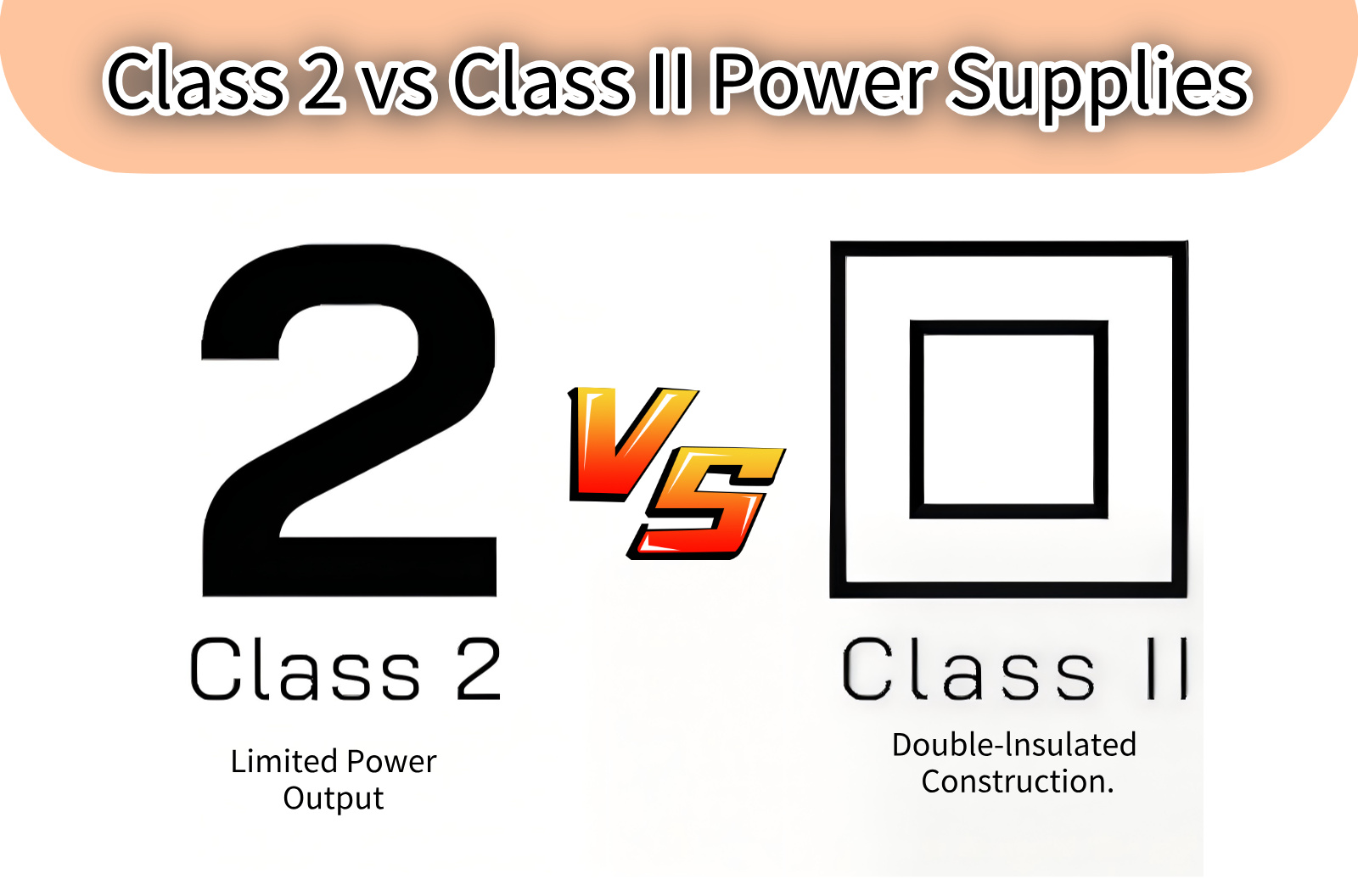
- Class 2: Refers to the output characteristics of a power supply or transformer (its circuit).
- Class II: Refers to the construction and insulation of the power supply’s enclosure (its product).
Think of it this way: Class 2 is about power limitation; Class II is about shock protection. They are governed by different standards and serve different primary purposes.
Deep Dive: What is a Class 2 Power Supply?
A Class 2 power supply is defined by the National Electrical Code (NEC) in the United States (Article 725). Its primary purpose is fire and shock prevention by limiting the available power output.
Key Characteristics:
- Power Limitation: It is designed to deliver a maximum of 100 Volt-Amperes (VA) and has strict limits on its output voltage and current under normal and fault conditions. This low energy level is considered inherently safer, reducing the risk of fire or a dangerous electric shock from the output wires.
- Regulated Output: It must maintain its safe limits even if a fault occurs internally.
- Wiring Benefits: In many jurisdictions, Class 2 circuits allow for the use of thinner-gauge, lower-cost wiring (like CL2-rated cable) without the need for metal conduit, as the risk is minimized.
Common Applications: LED lighting systems, thermostat wiring, doorbells, security system sensors, and low-power consumer electronics where safe, low-voltage wiring is an advantage.
Look for the Symbol: Often marked with the words “Class 2” or the symbol <span style="”color:" #2e86c1;”>◼ 2</span> on the label.
Deep Dive: What is a Class II Power Supply?
A Class II power supply (often denoted by the Roman numeral “II” or the symbol “◻” within a square) is defined by international safety standards like IEC 62368-1 (and its predecessor, IEC 60950-1). Its primary purpose is providing electric shock protection through double or reinforced insulation, without relying on a protective earth (ground) wire.
Key Characteristics:
- Double Insulation: The product has two independent layers of insulating material between the user and live internal parts. If one layer fails, the second provides protection. This eliminates the need for a grounding pin on the power plug.
- Construction-Based: It’s a physical design standard for the entire product enclosure and construction.
- Two-Pin Plug: You can typically identify a Class II appliance by its two-pin AC plug (no third grounding pin). Common examples include phone chargers, laptop power bricks, and many desktop lamps.
Common Applications: Virtually any consumer or IT appliance where a grounded connection is impractical or unnecessary for safety, and where robust, self-contained insulation is the chosen safety method.
Look for the Symbol: The official “double insulation” symbol is a small square inside another square: <span style="”color:" #e74c3c;”>◻</span>.
Side-by-Side Comparison Table
| Feature | Class 2 | Class II |
|---|---|---|
| What is Classified? | 的 Output Circuit (Power Limitations) | 的 Product Construction (Insulation) |
| Primary Goal | Prevent Fire & Shock via Energy Limitation | Prevent Shock via Double Insulation |
| Governing Standard | NEC (US), UL 1310 | IEC 62368-1 / 60950-1 (International) |
| Key Requirement | Strict limits on output Voltage, Current, and Power (≤ 100VA) | Two layers of protection between user and live parts |
| Grounding | May or may not have a protective earth. Not related to class. | Does NOT require a protective earth (ground) wire. |
| Visual Clue | Label says “Class 2” or symbol ◼ 2 | Label shows the double-square symbol ◻ or “Class II” |
| Typical Plug | Can be 2-pin or 3-pin; irrelevant to the class. | Almost always a 2-pin AC plug (no ground pin). |
The Critical Overlap: Can a Power Supply Be Both?
Yes, absolutely—and many modern power supplies are.
This is where confusion often arises. A single power supply unit can be designed to meet both sets of requirements:
- It can have a Class 2 low-energy output for safety and wiring convenience.
- It can be built with Class II double insulation so it doesn’t need a ground pin.
For example, the common “wall wart” for your smartphone is almost certainly a Class II device (two-pin plug, plastic case) that also provides a Class 2 low-voltage DC output.
How to Interpret: If a label has both markings, it means:
- Its construction is double-insulated (Class II).
- Its output is power-limited (Class 2).
Choosing the Right One: A Practical Guide
- For System Designers/Installers: If you are running low-voltage wires through walls or ceilings, you likely need a Class 2 power source to comply with building codes for safe wiring practices.
- For Product Designers/Engineers: If you are designing an end-product (like an appliance), you must decide on its safety class. Class II is common for portable, double-insulated devices. Your product’s safety class will determine the type of power supply it must use internally or be supplied with.
- For Purchasers/Consumers: For replacement parts, match the class markings. If your old device has a two-pin plug and the double-square symbol, replace it with a Class II supply. If your installation requires safe, low-power wiring, ensure the supply is Class 2 rated.
Conclusion
While “Class 2” and “Class II” are easily mistaken, they are distinct concepts governing different aspects of safety. Remember:
- Class 2 = Limited Power Output.
- Class II = Double-Insulated Construction.
Understanding this difference is essential for making informed decisions, ensuring regulatory compliance, and, most importantly, guaranteeing the safety of your electrical systems and products. Always check the specifications and symbols on your power supply label—that small detail carries significant meaning.
Disclaimer: This information is for educational purposes. Always consult the relevant local and national electrical codes (NEC, IEC, etc.) and safety standards for definitive compliance requirements in your specific application.
關於作者





新增評論