











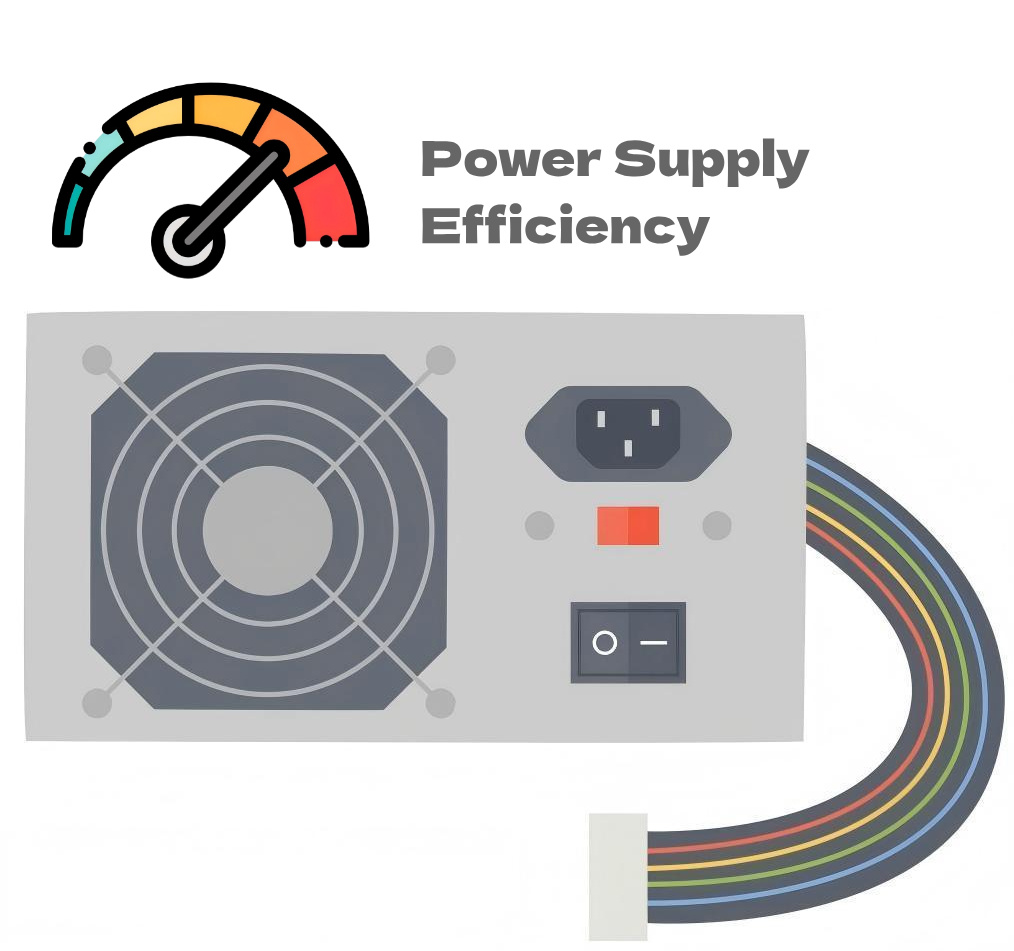
What Does Power Supply Efficiency Mean for Your System?
When selecting a power supply, the efficiency rating—often displayed as “80 Plus Bronze,” “Gold,” or “Platinum”—is more than just a technical specification or marketing term. It directly impacts your system’s performance, reliability, cost, and environmental footprint. Understanding what power supply efficiency means for your specific application is crucial for making an informed decision.
Understanding Efficiency: The Basics
Power supply efficiency is the ratio of useful output power to total input power, expressed as a percentage. Simply put, it measures how effectively a power supply converts incoming AC power into the DC power your system needs.
Efficiency (%) = (DC Output Power ÷ AC Input Power) × 100
If a power supply draws 100 watts from the wall (AC input) and delivers 85 watts to your components (DC output), its efficiency is 85%. The remaining 15 watts are lost as heat during the conversion process.
The Direct Impact on Your System
1. Thermal Performance and System Stability
The Heat Factor:
Every watt of inefficiency generates heat inside your power supply and system enclosure. A power supply with 85% efficiency versus one with 92% efficiency may seem like a small difference, but over time, that additional heat has significant consequences:
- Reduced Component Lifespan: Electronic components degrade faster at higher temperatures. For every 10°C increase above rated temperature, electrolytic capacitor life can be halved.
- Increased Fan Noise: To combat heat, cooling fans must work harder and faster, increasing audible noise—particularly noticeable in quiet office or home environments.
- Thermal Throttling Risk: In tightly packed systems (like servers or compact workstations), excess heat can cause other components (CPUs, GPUs) to throttle performance to avoid overheating.
- Recirculation Issues: The exhausted hot air can be drawn back into the system if ventilation is poor, creating a cycle of rising temperatures.
Example: A 750W power supply at 85% efficiency dissipates 112.5W as heat. The same unit at 92% efficiency dissipates only 60W as heat—a 47% reduction in heat generation.
2. Electrical Performance and Component Health
Efficiency correlates with electrical quality. Higher efficiency units typically feature:
- Superior voltage regulation: Tighter control of output voltages under varying loads
- Lower ripple and noise: Cleaner power delivery to sensitive components
- Better cross-load performance: Stable operation when outputs are unevenly loaded
These factors contribute to:
- Enhanced system stability (fewer crashes or unexpected reboots)
- Reduced electrical stress on connected components
- Longer lifespan for motherboards, drives, and other peripherals
3. Energy Costs and Operating Expenses
The financial impact of efficiency becomes substantial over time:
Calculation Example:
Consider a gaming PC with a 650W power draw during peak usage, operating 4 hours daily:
- 80 Plus Bronze (85% efficiency):
- AC input needed: 650W ÷ 0.85 = 765W
- Daily energy consumption: 765W × 4h = 3.06 kWh
- 80 Plus Platinum (92% efficiency):
- AC input needed: 650W ÷ 0.92 = 707W
- Daily energy consumption: 707W × 4h = 2.83 kWh
Annual Difference at $0.15/kWh:
(3.06 – 2.83) kWh/day × 365 days × $0.15 = $12.60 saved annually
For always-on systems (servers, NAS, security systems), the savings multiply dramatically. A server drawing 300W continuously saves approximately $45 annually when upgrading from 85% to 92% efficiency.
4. System Headroom and Future Upgrades
An efficient power supply operates cooler and more reliably near its maximum rated capacity. This provides:
- True capacity: A 750W Platinum unit may deliver closer to its rated power continuously than a 750W Bronze unit
- Upgrade flexibility: More efficient units often handle transient spikes better (like GPU power surges)
- Long-term reliability: When adding components, you’re less likely to push the power supply into inefficient, high-stress operating zones
Efficiency Across Load Ranges: Why the Curve Matters
Power supplies don’t maintain constant efficiency. The efficiency curve shows performance across different load percentages:
- Typical Peak Efficiency: 40-60% load
- Poor Efficiency Zones: Below 20% load and above 80% load (varies by design)
This means:
- Oversized PSUs waste power: A 1000W unit powering a 200W load operates in its least efficient range
- Correct sizing maximizes savings: Match your typical load to the power supply’s peak efficiency zone
Real-World Application Considerations
For Home/Office Computers:
- Typical benefit: Lower energy bills, quieter operation, moderate reliability improvement
- Recommended: 80 Plus Bronze or Gold, sized appropriately for your components
- Payback period: 2-4 years for the efficiency premium
For Gaming/Workstation PCs:
- Typical benefit: Better thermal management for overclocking, stable power for high-end GPUs
- Recommended: 80 Plus Gold or Platinum, with headroom for upgrades
- Key factor: High-efficiency units typically have better 12V rail performance for modern components
For Servers and Data Centers:
- Typical benefit: Substantial operational cost reduction, reduced cooling requirements
- Recommended: 80 Plus Platinum or Titanium
- Enterprise consideration: Higher efficiency directly reduces PUE (Power Usage Effectiveness)
For Industrial/Embedded Systems:
- Typical benefit: Reliability in harsh environments, reduced enclosure cooling needs
- Recommended: Industrial-grade units with high efficiency across operating temperatures
- Critical factor: Efficiency at both nominal and extreme temperatures
Beyond 80 Plus: Understanding the Certifications
While 80 Plus is the most recognized standard, understanding the tiers helps quantify benefits:
| Certification | Efficiency at 20% | 50% | 100% | Typical Use Case |
|---|---|---|---|---|
| 80 Plus | 80% | 80% | 80% | Basic systems |
| Bronze | 82% | 85% | 82% | Budget-conscious |
| Silver | 85% | 88% | 85% | Less common |
| Gold | 87% | 90% | 87% | Sweet spot for most |
| Platinum | 90% | 92% | 89% | High-end/Server |
| Titanium | 90% | 92% | 90% | Premium enterprise |
Note: Higher certification typically indicates better components, tighter tolerances, and superior build quality—factors that contribute to overall system reliability beyond just efficiency numbers.
The Hidden Benefits: Reliability and Sustainability
Component Stress Reduction:
Higher efficiency designs use:
- Better primary capacitors with longer lifespans
- Higher quality switching transistors
- More sophisticated control circuits
This translates to:
- Lower failure rates (especially important in critical applications)
- Better performance over the unit’s lifetime
- Longer warranty periods (manufacturer confidence in product)
Environmental Impact:
- Reduced carbon footprint: Less energy consumption means fewer greenhouse gas emissions
- Smaller cooling requirements: Lower heat output reduces air conditioning demands
- Extended product lifecycle: Longer-lasting components mean less electronic waste
Making the Right Choice: Efficiency vs. Cost
When Higher Efficiency Justifies the Cost:
- High-utilization systems (servers, mining rigs, 24/7 workstations)
- Hot environments where heat management is challenging
- Noise-sensitive applications where fan noise matters
- Systems with expensive components where power quality is critical
- Commercial installations where operational costs outweigh initial investment
When Good Enough is Actually Good Enough:
- Low-usage home systems (a few hours daily)
- Budget builds where every dollar counts
- Secondary or backup systems with minimal runtime
- Cool environments with excellent ventilation
- Temporary or short-term installations
Practical Selection Guidelines
- Calculate your actual power needs using online calculators or component specifications
- Size appropriately: Choose a unit where your typical load falls in the 40-60% range
- Consider your environment: Hot or confined spaces benefit more from high efficiency
- Evaluate usage patterns: More operating hours = faster efficiency premium payback
- Check the efficiency curve: Some units maintain high efficiency across broader load ranges
Conclusion: Efficiency as a System-Wide Investment
Power supply efficiency isn’t just about saving a few watts or dollars—it’s about building a better-performing, more reliable, and longer-lasting system. The right efficient power supply acts as a foundation that benefits every connected component through cleaner power, less heat, and reduced electrical stress.
For most users, stepping up from basic to Gold efficiency provides the best balance of cost and benefit. For mission-critical or high-utilization systems, Platinum or Titanium delivers tangible returns through operational savings and enhanced reliability.
Remember: The most efficient power supply is the one that’s correctly sized for your needs. An oversized Platinum unit may waste more power at low load than a properly sized Gold unit. Consider both the certification level and your actual usage patterns to maximize what efficiency means for your system.
Choosing a power supply? Look beyond just the wattage rating. Consider how efficiency impacts your specific application—from thermal management and noise levels to long-term operating costs. A slightly higher initial investment in an efficient unit often pays dividends throughout your system’s lifespan.
About author








Add comment