











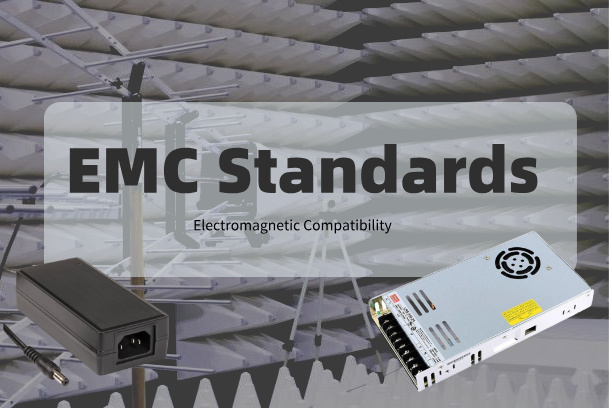
Understanding EMC Standards for Power Supplies
In today’s dense electronic ecosystem, a power supply cannot simply convert power efficiently—it must do so quietly. Electromagnetic Compatibility (EMC) is the discipline that ensures electronic devices, like power supplies, can operate without interfering with other equipment (Emissions) and are immune to interference from their environment (Immunity).
For power supply designers and system integrators, navigating EMC standards is not optional; it’s a critical requirement for market access, product reliability, and safety. This guide demystifies the core concepts, key standards, and practical importance of EMC compliance for power supplies.
Why EMC Matters for Power Supplies
Switching Mode Power Supplies (SMPS) are inherently noisy. Their high-speed switching transistors and rectifiers generate sharp voltage and current transitions, which are prolific sources of electromagnetic interference (EMI). Without proper design, this noise can:
- Radiate through the air or conduct back onto the AC mains, disrupting nearby radios, sensitive sensors, or communication networks.
- Cause malfunctions in the host equipment it is powering.
Conversely, a power supply must also resist interference from external sources to ensure stable output. EMC standards address both sides of this equation.
The Two Pillars of EMC
EMC testing is divided into two fundamental categories:
1. Emissions: Limiting Your Noise
This ensures the power supply does not emit excessive electromagnetic noise.
- Conducted Emissions: Measures high-frequency noise (typically 150 kHz to 30 MHz) that travels back onto the AC input power lines. This is the most common failure point for new designs.
- Radiated Emissions: Measures noise (typically 30 MHz to 1 GHz or higher) that is transmitted through the air as radio waves.
2. Immunity (or Susceptibility): Resisting External Noise
This tests the power supply’s ability to operate correctly in the presence of external interference.
- Key Tests Include:
- Electrostatic Discharge (ESD): Simulates a user touching the equipment or internal static discharges.
- Electrical Fast Transients (EFT/Burst): Simulates noise from switches, relays, or inductive loads disconnecting.
- Surge: Simulates high-energy transients from lightning strikes or major load shifts.
- Radiated & Conducted RF Immunity: Tests operation when subjected to strong radio frequency fields.
Key Global EMC Standards for Power Supplies
Standards are defined by international bodies and enforced by regional authorities. The most important families are:
A. International (IEC) Standards – The Foundation
The International Electrotechnical Commission (IEC) sets the baseline technical standards. For IT and general equipment power supplies, the overarching standard is:
- IEC 62368-1: The hazard-based safety standard for Audio/Video, Information & Communication Technology equipment. It incorporates EMC requirements by reference.
- The CISPR Family: This is the core of emissions standards within the IEC.
- CISPR 32: Specifically for multimedia equipment emissions. This is the primary emissions standard for most commercial AC-DC power supplies as stand-alone units or as components in equipment.
- CISPR 35: Defines the immunity requirements for multimedia equipment.
B. Regional Regulations – The Law
- European Union (EU): The EMC Directive (2014/30/EU) mandates CE marking. Compliance with harmonized standards like EN 55032 (identical to CISPR 32) and EN 55035 (identical to CISPR 35) provides a presumption of conformity.
- United States: The Federal Communications Commission (FCC) regulates emissions under Title 47 CFR Part 15, Subpart B. For power supplies, the relevant limits are typically for “unintentional radiators” (Class A for industrial, Class B for residential).
- Other Regions: Similar regulations exist worldwide (e.g., KC in Korea, RCM in Australia, VCCI in Japan), often based on IEC/CISPR standards.
How Power Supply Design Achieves EMC Compliance
Meeting these standards requires deliberate design from the first schematic entry:
- Filtering (For Emissions): An EMI filter at the AC input, consisting of X and Y safety capacitors and a common-mode choke, is critical to suppress conducted noise. Proper PCB layout with small high-frequency loops and local decoupling is equally important.
- Shielding & Layout (For Radiated Emissions): Using a metal enclosure or can, ensuring good electrical contact (seams, gaskets), and strategic placement of transformers and heatsinks help contain radiated noise.
- Protection Circuits (For Immunity): Transient Voltage Suppression (TVS) diodes and metal oxide varistors (MOVs) at the input clamp surges and transients. Ferrite beads and robust filtering protect against conducted RF. Good grounding and layout are essential for ESD and EFT immunity.
- Component Selection: Using components with lower parasitic inductance/capacitance and MOSFETs with softer switching characteristics can reduce noise at the source.
The Compliance Process: From Lab to Market
- Pre-compliance Testing: Conducting basic emissions scans in-house using near-field probes or a pre-compliance chamber to identify major issues early, saving significant time and cost.
- Formal Testing at an Accredited Lab: A prototype is submitted to an accredited test laboratory for full, audited testing against the target standards.
- Documentation & Declaration: Upon passing, the manufacturer creates a Technical Construction File (TCF) and signs a Declaration of Conformity (DoC).
- Affixing the Mark: The compliant product can then bear the required mark (CE, FCC, etc.).
Conclusion
EMC standards for power supplies are not arbitrary hurdles; they are essential frameworks that ensure the reliable and harmonious operation of all electronic devices in our interconnected world. Understanding the dual focus on emissions and immunity, the structure of IEC/CISPR standards, and their implementation into regional regulations is crucial for any professional involved in bringing a power supply or powered product to market.
Successful EMC compliance is achieved not by last-minute fixes, but by integrating sound EMC principles into the fundamental design—considering filtering, layout, shielding, and protection from the very beginning. By doing so, you ensure your power supply is not just a source of energy, but a good neighbor in the electromagnetic spectrum.
About author









Add comment