











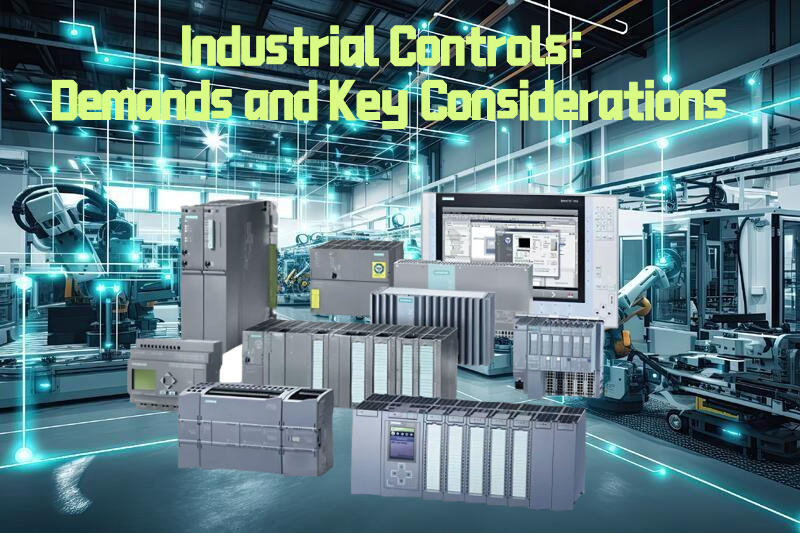
Industrial Controls: Demands and Key Considerations
Industrial control systems form the operational backbone of modern manufacturing, energy production, and critical infrastructure. Moving beyond simple automation, today’s systems must balance relentless demands for uptime and precision with the complexities of connectivity, cybersecurity, and evolving regulations. Selecting, designing, and maintaining these systems requires a strategic understanding of their core demands and the critical factors that determine success or failure.
This guide explores the essential demands placed on industrial controls and provides a framework for the key considerations in their implementation.
Part 1: The Non-Negotiable Demands on Modern Industrial Controls
Industrial environments are unforgiving. Control systems are not just expected to function; they are required to excel under the following pressures:
1. Reliability & Uptime (The Prime Directive)
- 24/7/365 Operation: Many processes cannot be stopped without massive financial loss or safety risks. The demand is for continuous, predictable operation.
- Mean Time Between Failure (MTBF): Components and systems are specified for extremely long operational life, often measured in decades for core infrastructure.
- Predictable Performance: Control loops must execute with deterministic timing, where a known input always produces the same output within a guaranteed time frame.
2. Robustness & Environmental Hardening
- Physical Extremes: Controls must operate in environments with wide temperature swings (-40°C to 70°C+), high humidity, vibration from machinery, and corrosive atmospheres (dust, oil, chemicals).
- Electrical Noise Immunity: Factories are electrically noisy environments with large motors, welders, and RF interference. Controls must have high noise immunity and proper isolation to prevent false signals or resets.
- Ingress Protection (IP Ratings): Enclosures and devices must be rated (e.g., IP65, IP67) to protect against dust and water ingress specific to their location.
3. Precision & Determinism
- High-Speed Control Loops: Applications like robotics, motion control, and CNC machining require loop updates in microseconds to milliseconds.
- Synchronization: Multi-axis systems and distributed I/O often require precise synchronization, often managed by protocols like IEEE 1588 (Precision Time Protocol).
- Repeatability: The system must produce identical results batch after batch, which depends on the precision of sensors, controllers, and actuators.
4. Safety & Functional Safety
- Personnel Protection: Systems must integrate safety components (e.g., light curtains, e-stops, safety-rated PLCs) that comply with standards like ISO 13849 and IEC 62061 to prevent injury.
- Process Safety: Preventing catastrophic failures (overpressure, overtemperature) that could damage equipment or the environment, guided by standards like IEC 61511.
- Safety Integrity Level (SIL): Systems are certified to specific SIL levels (1-4), defining the required probability of failure on demand for safety functions.
5. Connectivity & Interoperability (Industry 4.0)
- Vertical Integration: Seamless data flow from the sensor/actuator level (Field-level: IO-Link, AS-i) to the control level (Controller-level: Ethernet/IP, PROFINET) to the enterprise cloud (Cloud-level: OPC UA, MQTT).
- Multi-Vendor Interoperability: The ability to integrate best-in-class components from different manufacturers using open standards.
- Data Accessibility: Providing clean, contextualized data for analytics, predictive maintenance, and overall equipment effectiveness (OEE) calculations.
Part 2: Key Considerations for System Design & Selection
Meeting the above demands requires deliberate planning. Here are the critical considerations at each stage.
1. Architectural Strategy: Centralized vs. Distributed
- Centralized Control: Traditional model with a central PLC/PC overseeing everything. Pros: Easier programming/management. Cons: Single point of failure, extensive and costly wiring.
- Distributed Control: Intelligence is pushed to the edge with smart I/O, drives, and sensors networked together. Pros: Reduced wiring, increased flexibility, scalability. Cons: More complex network management and software coordination.
- Hybrid Approach: Most modern systems use a hybrid, with central logic for coordination and distributed intelligence for local fast-loop control.
2. Network & Communication Backbone
- Deterministic vs. Non-Deterministic: Control networks (EtherCAT, PROFINET IRT) guarantee delivery within a defined time, while IT networks (standard Ethernet) are “best-effort.”
- Bandwidth & Topology: Assess data volume, update rates, and choose a robust topology (star, ring, line). Industrial Ethernet rings with rapid spanning tree protocol offer high availability.
- Single Network vs. Segmented Networks: Often, control traffic is separated from safety traffic and general data traffic for performance and security reasons.
3. Cybersecurity by Design
- Defense-in-Depth: Implement multiple layers: network segmentation (firewalls between OT/IT), secure device configuration (disable unused ports/ services), strict access control, and monitoring.
- Lifecycle Management: Plan for secure remote access (VPNs), patch management strategies for controllers and embedded devices, and asset inventory.
- Standards Compliance: Adhere to frameworks like ISA/IEC 62443, which provides a systematic approach to securing industrial automation and control systems (IACS).
4. Power Supply & Power Quality
- Clean, Stable Power: Industrial controls require regulated, low-noise DC power (typically 24VDC). Voltage sags, spikes, or electrical noise can cause unpredictable behavior.
- Redundancy: For critical processes, consider redundant power supplies with automatic switchover.
- Protection: Proper circuit protection (fusing, circuit breakers) and potential isolation are mandatory. Uninterruptible Power Supplies (UPS) may be needed for orderly shutdown.
5. Maintenance & Supportability
- Diagnostic Capabilities: Choose devices and software with rich diagnostics (detailed error codes, web servers for status, trending tools) to minimize Mean Time To Repair (MTTR).
- Spare Parts Strategy: Ensure long-term availability of critical components. Consider the lifecycle status of all selected hardware.
- Documentation & Training: Comprehensive documentation (schematics, network diagrams, program comments) and trained personnel are the ultimate insurance policy for system longevity.
6. Scalability & Future-Proofing
- I/O Capacity: Design with 20-30% spare I/O capacity for future modifications.
- Processing Headroom: Ensure the controller has CPU and memory headroom for additional logic or data handling.
- Technology Roadmap: Select vendors with a clear commitment to open standards and a migration path for future technologies.
Conclusion: A Systems Engineering Mindset
Success in industrial controls is not about selecting the most powerful PLC or the fastest network in isolation. It is a systems engineering challenge that requires balancing competing demands:
- Balancing Performance with Cost
- Balancing Openness with Security
- Balancing Cutting-Edge Features with Proven Reliability
The most resilient systems are designed holistically, with a clear understanding of the process requirements, operational environment, and total cost of ownership. By methodically addressing the core demands and key considerations outlined here, you can build a control system that is not just functional, but robust, secure, and ready for the future of industrial operations.

About author










Add comment