










การทำงานของแหล่งจ่ายไฟ AC-DC: การแปลง, การควบคุมแรงดัน, และการออกแบบ
The humble AC-DC power supply is an unsung hero of the modern world. Nestled in wall adapters, computer towers, and industrial equipment, it performs the essential but often overlooked task of converting the Alternating Current (AC) from your wall outlet into the stable, low-voltage Direct Current (DC) that our electronics crave.
Understanding how these ubiquitous devices work is key for anyone involved in electronics, from hobbyists to professional designers. This article breaks down the process into three fundamental stages: Conversion, Regulation, and Design Considerations.
Stage 1: Conversion – From AC to Raw DC
The journey begins with converting the high-voltage AC mains (e.g., 120VAC or 230VAC) into a usable DC voltage.
1. Transformation & Rectification (The Classic Path)
This is the core of a traditional linear power supply.
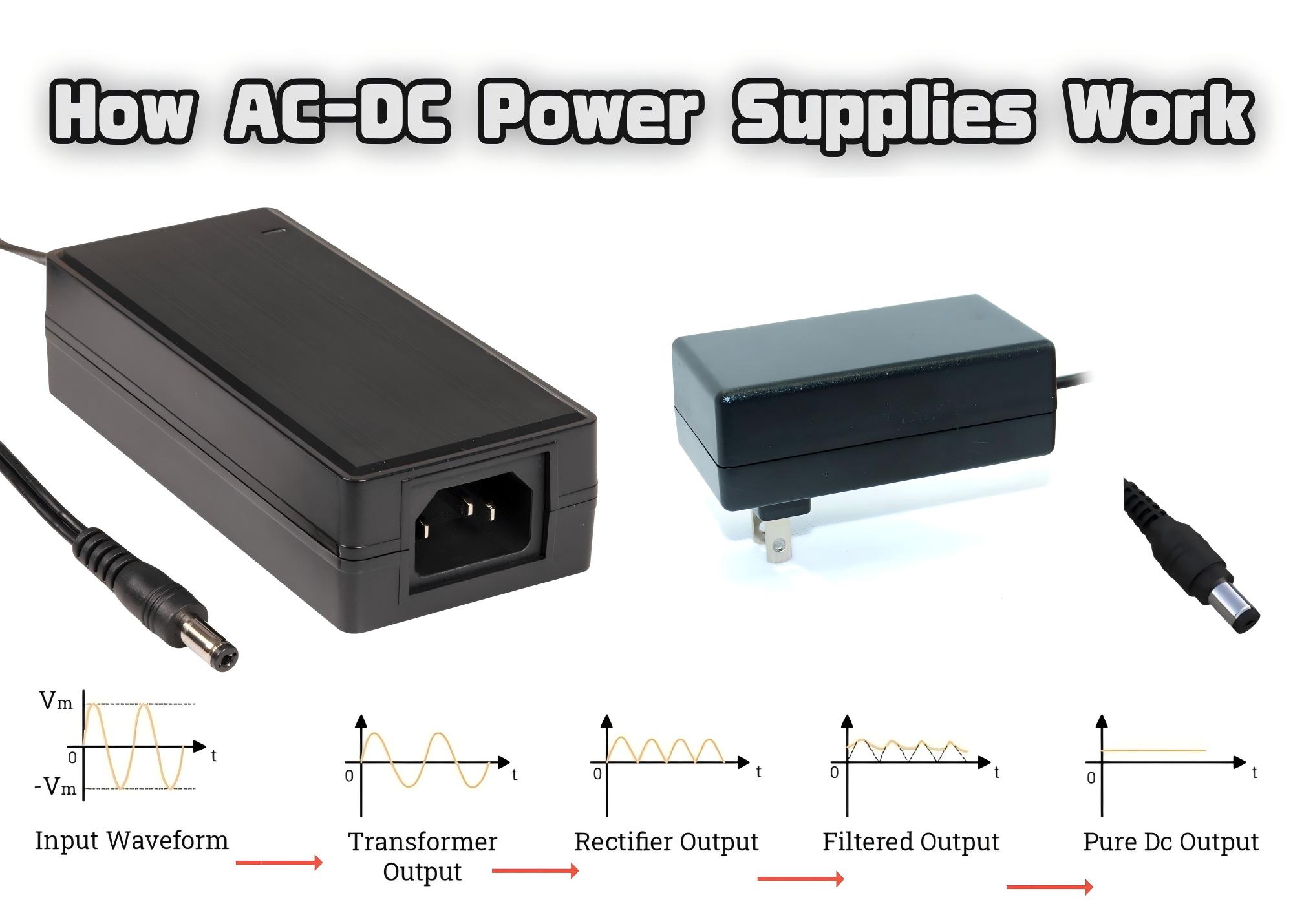
- Step A: Transformer: The AC voltage is first passed through a transformer to step it down to a lower AC voltage, closer to the desired DC output (e.g., 12VAC).
- Step B: Rectification: This lower AC voltage is then fed into a rectifier, typically a bridge of four diodes. The rectifier acts as a one-way valve, allowing current to flow in only one direction. It converts the sinusoidal AC wave into a pulsating series of positive humps—a raw, unsteady DC voltage.
2. High-Frequency Switching (The Modern Standard)
Today, over 90% of AC-DC supplies use Switched-Mode Power Supply (SMPS) technology for its superior efficiency and compact size.
- Step A: Rectification & Filtering: The AC input is immediately rectified to high-voltage DC (using diodes and a capacitor). There’s no bulky low-frequency transformer at this stage.
- Step B: High-Frequency Switching: This high-voltage DC is then “chopped” at a very high frequency (tens to hundreds of kHz) by a power transistor (e.g., a MOSFET). This creates a high-frequency AC square wave.
- Step C: Transformation & Rectification: The high-frequency AC is passed through a tiny, high-frequency ferrite-core transformer, which steps the voltage down efficiently. Finally, it is rectified and filtered again to produce a raw DC output.
Key Takeaway: Both methods end with a raw DC voltage, but an SMPS achieves it more efficiently by using high-frequency switching, allowing for a much smaller and lighter magnetic components.
Stage 2: Regulation – Taming the Raw DC
The raw DC voltage from Stage 1 is not clean or stable enough for sensitive electronics. It varies with input fluctuations and load changes, and contains ripple (residual AC noise). Regulation fixes this.
1. Linear Regulation (Simple & Clean)
- How it works: A linear regulator (like a 78-series IC) acts as a “smart variable resistor.” It drops the excess voltage between the input (raw DC) and the desired output, dissipating the difference as heat.
- Pros: Extremely simple, cheap, and provides a very “quiet” (low-noise) output.
- Cons: Inefficient, especially when the input voltage is much higher than the output. The wasted energy becomes heat, requiring heatsinks.
2. Switching Regulation (Efficient & Versatile)
- How it works: In an SMPS, regulation is integral to the conversion process. A feedback control circuit (PWM controller) continuously monitors the output voltage. If it starts to dip or rise, the circuit instantly adjusts the duty cycle (the on/off time) of the high-frequency switching transistor. This controls the energy transferred to the output, holding the voltage rock-steady.
- Pros: Highly efficient (often >85%), minimal heat generation, and can handle wide input ranges.
- Cons: More complex design and generates high-frequency electrical noise (EMI) that must be filtered.
Stage 3: Key Design Considerations & Trade-offs
Designing or selecting an AC-DC power supply involves balancing several critical factors:
- Efficiency: The percentage of input power delivered to the load. SMPS designs dominate here. Higher efficiency means lower energy bills, less heat, and often a smaller form factor.
- Size and Weight: SMPS technology, with its high-frequency components, enables the compact “wall wart” adapters and internal power supplies we use today. Linear supplies with their low-frequency transformers are large and heavy by comparison.
- Output Noise & Ripple: Critical for sensitive analog or RF circuits. Linear regulators provide the cleanest output. SMPS designs require careful filtering and layout to suppress switching noise.
- Power Factor (PF): Especially important for higher-power supplies (>75W). A low PF means the supply draws current inefficiently from the grid. Power Factor Correction (PFC) circuits are added to modern SMPS designs to mitigate this.
- Safety & Isolation: A fundamental requirement. The isolation barrier (provided by the transformer in both linear and SMPS) physically separates the dangerous high-voltage AC input from the user-accessible low-voltage DC output. This is critical for preventing electric shock and is governed by strict international standards (e.g., UL, IEC).
Design Choice Summary:
| Feature | Linear Power Supply | Switched-Mode Power Supply (SMPS) |
|---|---|---|
| Efficiency | Low (30-60%) | High (70-95+%) |
| Size/Weight | Large/Heavy | Small/Light |
| Output Noise | Very Low | Higher (requires filtering) |
| Complexity | Simple | Complex |
| Cost | Low (for low power) | Competitive (esp. at higher power) |
| Best For | Low-power, noise-sensitive audio/analog circuits, lab bench supplies | Virtually all modern applications: consumer electronics, computing, industrial systems. |
Conclusion
An AC-DC power supply is more than just a plug and a box. It is a sophisticated system that performs the vital tasks of safe conversion, precise regulation, and efficient power delivery. While the underlying principles of rectification and filtering remain constant, the advent of high-frequency switching technology has revolutionized their design, enabling the powerful, efficient, and compact units that fuel our digital world.
Whether you’re troubleshooting a device or specifying a power supply for your next project, understanding these core concepts—conversion, regulation, and the inherent design trade-offs—empowers you to make informed and effective decisions.
About author





Add comment