










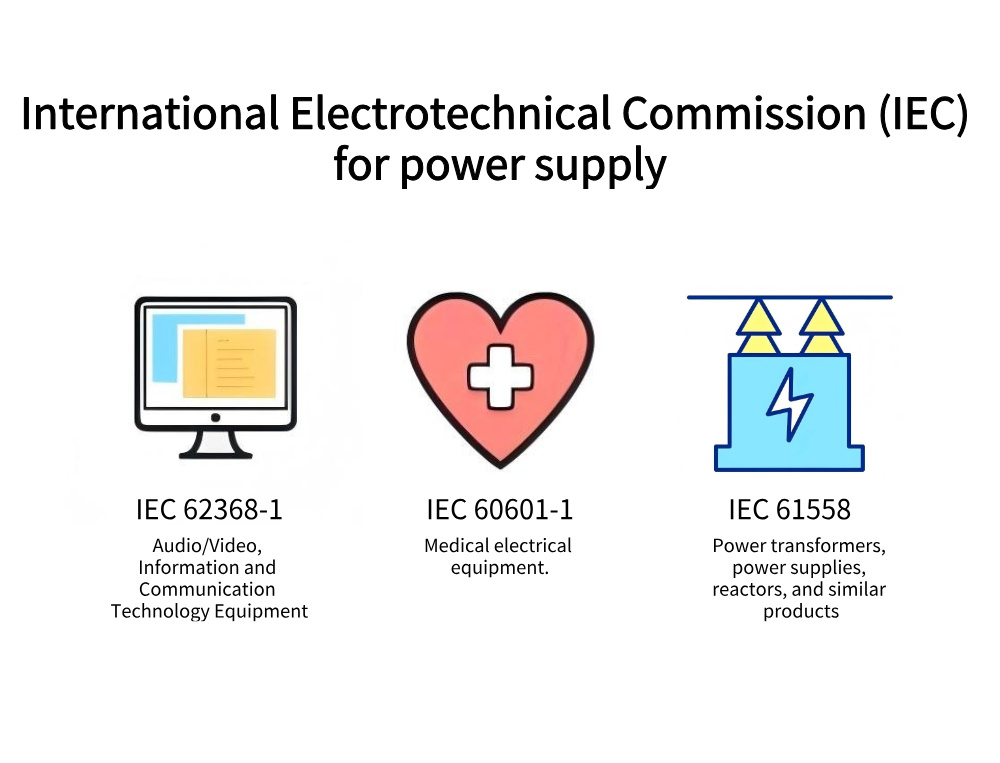
International Electrotechnical Commission (IEC) for power supply
Excellent focus. The Comissão Eletrotécnica Internacional (CEI) is absolutely foundational for power supplies—both the devices themselves and the broader power systems they connect to.
Here’s a breakdown of the IEC’s critical role in this domain.
Core Relevance to Power Supplies
The IEC provides the universal “rulebook” that ensures power supplies are safe, reliable, efficient, and interoperable anywhere in the world. Compliance with IEC standards is often a legal requirement for market access.
Key IEC Standards for Power Supplies
Standards are broadly divided into two categories: Safety & Performance e Connectors & Interfacing.
1. Safety Standards (Non-Negotiable)
These are the most critical, protecting users from electric shock, fire, and energy hazards.
- IEC 62368-1: The paramount standard. This is the hazard-based safety standard for Audio/Video, Information and Communication Technology Equipment. It covers almost all modern AC-DC and DC-DC power supplies used in IT equipment, consumer electronics, and appliances. It superseded the older IEC 60950-1 and IEC 60065.
- IEC 61558: Safety for power transformers, power supplies, reactors, and similar products. This is crucial for lower-power, isolating transformers and supplies, often found in household appliances, lighting, and control circuits.
- IEC 60601-1: Safety for medical electrical equipment. Power supplies for medical devices must meet these extremely stringent requirements for patient and operator safety (including leakage current limits).
2. Performance, Testing & Environmental Standards
These define how a power supply should perform under various conditions.
- IEC 61000-4 (Series): Electromagnetic Compatibility (EMC) immunity testing. Defines how a power supply must withstand external disturbances like surges (IEC 61000-4-5), electrostatic discharge (IEC 61000-4-2), and voltage dips.
- IEC 61000-3-2: Limits harmonic current emissions (for equipment with input current ≤16A per phase). Ensures the power supply doesn’t pollute the AC mains with distortion.
- IEC 60068 (Series): Environmental testing. Covers procedures for vibration, shock, humidity, and temperature cycling to ensure reliability.
- Efficiency Standards: While often regional (like ENERGY STAR or EU Ecodesign), they are built upon IEC 62301 (measurement of standby power) and IEC 62053 (measuring energy consumption).
3. Connector, Wiring & Mounting Standards (Critical for Interoperability)
The IEC standardizes the physical interfaces, ensuring plugs fit and pinouts are correct.
- IEC 60320: The universal standard for appliance couplers. This is what defines the ubiquitous IEC C13/C14 connectors (the “kettle lead” on desktop PCs and monitors) and C5/C6 connectors (“cloverleaf” for laptops). It ensures safe disconnection under load.
- IEC 60906: A less common attempt at a universal mains plug/socket system.
- IEC 61140: Protection against electric shock (common grounding/bonding principles).
- IEC 60529: IP (Ingress Protection) Code (e.g., IP67). Defines levels of sealing against dust and water for power supply enclosures.
4. Standards for Specific Power Supply Applications
- IEC 62477-1: Safety requirements for power electronic converter systems and equipment (e.g., motor drives, photovoltaic inverters).
- IEC 61204: Low-voltage power supply devices – Performance requirements for DC output power supplies (e.g., for telecoms).
- Uninterruptible Power Supplies (UPS): Covered by the IEC 62040 series.
The IEC “Ecosystem” for Power Supply Manufacturers
- Design: Engineers use IEC standards as the design blueprint.
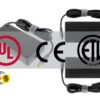
- Testing & Certification: Products are tested in accredited labs (like UL, TÜV) to the IEC standards. The IECEE CB Scheme is key here.
- IECEE CB Scheme: This is the critical pathway for global market access. A manufacturer can get a CB Test Report and Certificate from a member country. This report, based on IEC standards, is then accepted by certification bodies in other member countries, greatly simplifying national certifications (like NRTL in the USA or PSE in Japan).
Impact on the Industry & End-Users
- Safety: Prevents catastrophic failures.
- Global Trade: A power supply built to IEC 62368-1 with a CB Certificate can be adapted for most global markets with minimal re-testing.
- Predictability: Specifiers (e.g., a laptop manufacturer) can source compliant power supplies from any vendor, knowing they meet baseline safety and performance criteria.
- User Experience: Standardized connectors (IEC 60320) mean you can often use the same power cord for different devices.
In essence, for the power supply industry, the IEC is not just an organization—it is the essential framework. It turns the chaotic problem of delivering safe, universal power into a standardized, global engineering discipline. Whether it’s the wall wart charging your phone or the industrial PSU in a server rack, it lives and breathes IEC standards.
About author






Add comment