











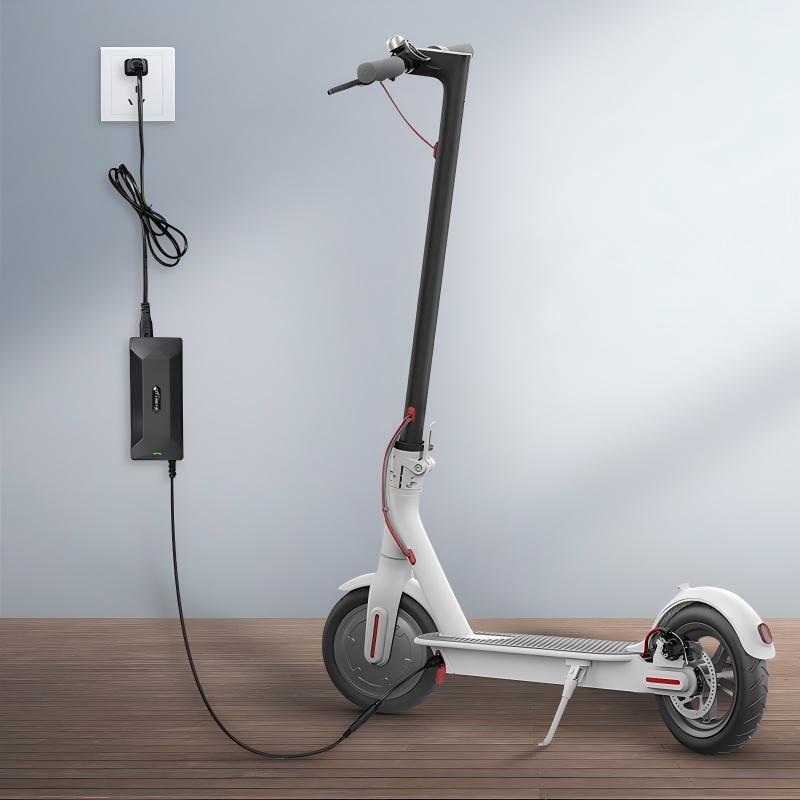
AC, DC, Fast, or Standard? Your Guide to Scooter Charger Types
Choosing a charger for your electric scooter might seem simple—just plug in the one that came in the box. But what happens when you need a replacement, want a faster charge, or plan a longer ride that requires a top-up on the go? Suddenly, you’re faced with a choice: AC, DC, Fast, or Standard? Understanding these charger types is key to optimizing your scooter’s performance, battery health, and your own convenience.
This guide breaks down the different electric scooter charger types, explaining what they are, how they work, and which one is right for your riding lifestyle.
The Core Distinction: AC vs. DC Chargers
First, let’s tackle the fundamental difference that determines where you can charge.
1. AC Chargers (The “Wall Plug” Standard)
- 내용입니다: This is the standard charger included with virtually every scooter. It converts Alternating Current (AC) from your household wall outlet into the Direct Current (DC) your scooter’s battery can store.
- How it looks: A power brick (sometimes with a cooling fan) with two cables: one to the wall, and one to your scooter.
- Best for: Overnight charging at home or the office. It’s your reliable, everyday workhorse.
- 장점: Universally compatible with wall outlets, generally lower cost, and designed by the manufacturer for optimal battery health.
- 단점: Tied to a wall outlet. Charging speed is typically standard (slower).
2. DC Chargers (The “On-The-Go” Solution)
- 내용입니다: This charger plugs into a 12V 또는 24V DC socket, like the cigarette lighter port in a car, RV, or boat. It boosts and regulates the vehicle’s DC power to match your scooter’s battery voltage.
- How it looks: Often a smaller, cylindrical module with a plug for the car socket.
- Best for: Riders who use a car for transport (e.g., driving to a trailhead) or anyone needing a mid-journey top-up during long excursions.
- 장점: Ultimate flexibility for charging anywhere you have vehicle access. A lifeline for range anxiety.
- 단점: Charging speed is usually slow (limited by the car’s electrical system). Requires you to have your vehicle nearby.
Verdict: Your AC charger is for primary charging, while a DC charger is a strategic backup for extended adventures or multi-modal commuting.
The Speed Factor: Standard vs. Fast Chargers
This distinction is about how long you’re willing to wait for a full battery. It’s primarily determined by the charger’s output current, measured in Amps (A).
1. Standard Chargers (The Battery Caretaker)
- Output: Typically 1.5A to 2.5A.
- Charge Time: Usually 4 to 8 hours for a full charge.
- 작동 방식: Uses a gentler, lower-current charge curve. It’s the charger that came with your scooter.
- Best for: Overnight charging and maximizing battery lifespan. The slower, cooler charge generates less heat and stress on the battery cells.
- 장점: Promotes long-term battery health, often more affordable, and runs cooler.
- 단점: It’s slow. You can’t quickly top up before an unexpected trip.
2. Fast Chargers (The Time Savers)
- Output: Typically 3A to 5A+.
- Charge Time: Can cut total charge time by 30-50% (e.g., from 6 hours down to 2-3 hours).
- 작동 방식: Pumps a higher current into the battery. Crucially, it must be compatible with your scooter’s Battery Management System (BMS) to communicate and charge safely.
- Best for: Riders with tight schedules, delivery workers, or anyone who needs a quick turnaround. Ideal for a midday top-up.
- 장점: Dramatically reduces downtime. Adds significant range in a short lunch break.
- 단점: Generates more heat, which can accelerate long-term battery degradation if used exclusively. Never use a fast charger not approved for your scooter model, as it can cause damage or fire.
Verdict: Use the Standard charger for your routine overnight charges to preserve battery life. Keep a compatible Fast charger for situations where speed is essential.
Smart Chargers: The Intelligent Hybrid
Many modern chargers, especially for higher-end scooters, are “smart.” This isn’t a separate type, but a valuable feature that can apply to AC, DC, Fast, or Standard models.
- What they do: A smart charger communicates with the scooter’s BMS to optimize the charge cycle. It may automatically switch to a trickle charge at the end, have a “storage mode” (charging to ~60-80% for long-term health), or display charge status via LED colors.
- Key Benefit: They provide an extra layer of battery protection and longevity by preventing overcharging and optimizing the charge curve.
Charger Type Comparison Table
| Charger Type | Power Source | Typical Speed | Primary Use Case | Key Consideration |
|---|---|---|---|---|
| Standard AC | Wall Outlet (AC) | Slow (1.5A-2.5A) | Routine, overnight charging at home/office. | Battery longevity champion. Your default choice. |
| Fast AC | Wall Outlet (AC) | Fast (3A-5A+) | Quick top-ups, high-usage riders, delivery. | Must be model-compatible. Generates more heat. |
| DC (Car) | Vehicle Socket (DC) | Slow to Moderate | On-the-go charging, range extension, adventures. | Flexibility tool. Requires vehicle access. |
| Smart Charger | AC or DC | Varies | All users wanting optimized battery health. | Look for features like auto-cutoff, storage mode. |
How to Choose: A Simple Decision Flowchart
- What is your PRIMARY need?
- “I just need to replace my broken charger.” → Buy an exact OEM (Original Equipment Manufacturer) replacement. Match the voltage (e.g., 42V, 52V) and connector precisely.
- “I want to charge faster sometimes.” → Purchase a manufacturer-approved Fast Charger for your specific scooter model. Use it sparingly.
- “I need to charge from my car.” → Buy a compatible DC Car Charger matching your scooter’s voltage.
- Always Check These Three Specs Before Buying:
- Output Voltage (V): Must EXACTLY match your scooter battery (e.g., 36V, 48V, 52V).
- Output Current (A): Determines speed. Higher A = faster charge.
- Connector Plug: Must be the correct physical shape and polarity (e.g., XLR, GX16, proprietary barrel jack).
Final Recommendation: The Balanced Approach
For most riders, the ideal setup is a two-charger strategy:
- Primary: Use your Standard AC Charger for 90% of your charging needs. This is the best practice for battery health.
- Secondary: Own a compatible Fast AC Charger for when you’re in a pinch, and/or a DC Car Charger if your lifestyle demands mobile flexibility.
By understanding the roles of AC, DC, Fast, and Standard chargers, you move from being a passive user to an informed owner. You can now make choices that not only fit your schedule but also actively protect your scooter’s most expensive and critical component: its battery.

작성자 정보







댓글 추가