
Nessun prodotto nel carrello.











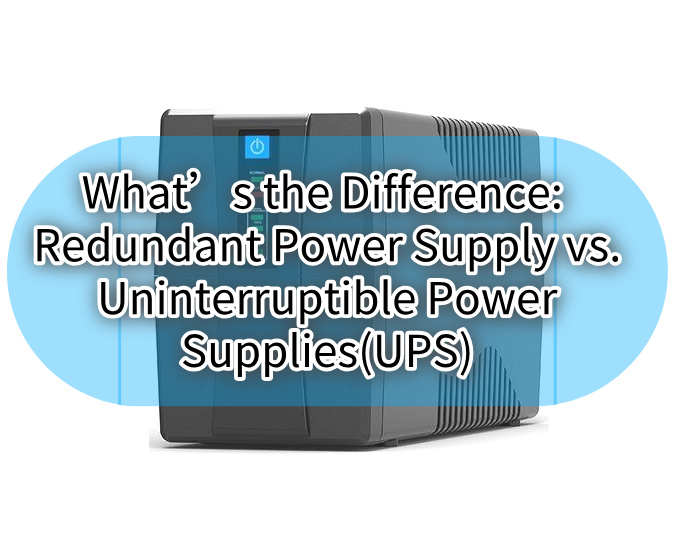
What’s the Difference: Redundant Power Supply vs. Uninterruptible Power Supplies(UPS)?
In industrial automation, data centers, and critical infrastructure, ensuring uninterrupted power is non-negotiable. Two common solutions—Redundant Power Supplies and Uninterruptible Power Supplies (UPS)—are often mentioned together, but they serve distinct purposes. Understanding their differences is key to designing a resilient power system.
? Redundant Power Supply: Parallel Reliability
A Redundant Power Supply system typically involves two or more power supply units connected in parallel to share the load. If one unit fails, the other(s) immediately take over the full load without interruption.
How It Works:
- Two or more power supplies are connected to the same AC input and same DC output bus.
- They operate in parallel, often with current-sharing circuitry.
- If a unit fails, the remaining unit(s) seamlessly support the connected devices.
- Sometimes implemented with diode isolation modules to prevent back-feeding into a failed unit.
Primary Purpose:
- High availability and system uptime by eliminating a single point of failure in the power supply itself.
- Protects against power supply hardware failure, not against AC input power loss.
Best Used For:
- Critical control systems (PLCs, DCS, safety systems).
- Servers, networking equipment with dual power inputs.
- Industrial PCs and automation hardware where downtime is costly.
⚡ Uninterruptible Power Supply (UPS): Bridging Power Gaps
A UPS provides temporary backup power from batteries (or flywheels) when the main AC power fails. It ensures connected equipment continues to run or shuts down gracefully during a power outage.
Types of UPS:
- Standby (Offline) UPS – Switches to battery when AC fails (short switchover time).
- Line-Interactive UPS – Regulates voltage and switches to battery when needed.
- Online (Double-Conversion) UPS – Continuously converts AC to DC and back to AC, providing complete isolation from line disturbances.
Primary Purpose:
- Protection against AC power failures, brownouts, sags, and surges.
- Provides ride-through time during short outages or until a generator starts.
- Allows for orderly shutdown of systems during prolonged outages.
Best Used For:
- Computers, servers, and IT infrastructure.
- Critical instruments in labs, healthcare, or telecom.
- Any application where even brief power loss is unacceptable.
? Key Differences at a Glance
| Feature | Redundant Power Supply | UPS |
|---|---|---|
| Purpose | Prevents failure due to power supply unit fault | Prevents failure due to AC input power loss |
| Protection Against | Internal PSU failure, component wear | Power outages, brownouts, voltage fluctuations |
| Backup Source | Other parallel PSU(s) | Batteries, supercapacitors, or flywheels |
| Runtime During Outage | None – relies on AC input | Minutes to hours, depending on battery size |
| Typical Use Case | High-availability systems with stable AC power | Systems needing ride-through during power events |
| Cost | Moderate (extra PSU hardware) | Higher (especially for long-runtime batteries) |
?️ Practical Scenarios: Which One Do You Need?
Scenario 1: PLC Controlling a Production Line
- Problem: Power supply failure stops the line.
- Solution: Redundant DIN-rail power supplies ensure that if one fails, the other keeps the PLC running.
- UPS? Not necessary if the facility has stable grid/generator power.
Scenario 2: Server Running a Database
- Problem: Short grid outage corrupts data.
- Solution: A UPS provides immediate battery power during outages and allows time for graceful shutdown or generator start.
- Redundant PSUs? Also useful if the server supports them, to protect against internal PSU failure.
Scenario 3: Critical Monitoring System in a Remote Site
- Problem: Both power outages and hardware failure risk data loss.
- Solution: Combine both – use redundant power supplies fed by a UPS. This protects against AC failure and PSU failure simultaneously.
✅ Can They Work Together? Absolutely.
In mission-critical applications, the best practice is often layered protection:
text复制下载
AC Mains → UPS → [Conditioned AC] → Redundant Power Supplies → Critical Load
This approach:
- Provides battery backup during outages (UPS function)
- Ensures continuous operation if one power supply fails (Redundancy)
- Cleans power quality issues before they reach sensitive electronics
For example, many data center servers feature dual hot-swap power supplies, each plugged into separate UPS-backed power feeds. This protects against both PSU failure and power path failure.
? Selection Checklist
Ask these questions when deciding:
- Is the main risk power supply failure or AC power failure?
- How long can the system tolerate no power? (Seconds → Redundant PSU; Minutes → UPS)
- Does the equipment have dual power input capability?
- Is there already generator backup? (Maybe only redundant PSU needed)
- What’s the budget? (UPS systems with large battery banks cost more)
? Bottom Line
- Redundant Power Supplies are about hardware reliability – ensuring the power conversion hardware doesn’t fail.
- UPS is about power continuity – ensuring AC power is always present, even when the grid fails.
For truly critical systems, the question isn’t “Redundant PSU or UPS?” – it’s “How can I implement both for maximum resilience?”
Looking to design a fault-tolerant power system? Consider your failure scenarios, uptime requirements, and layer your protection accordingly. Sometimes the best solution is a UPS feeding redundant power supplies, giving you the best of both worlds.
About author

Related posts

Choosing the right voltage for your power supply is a critical decision that affects performance, safety, and longevity of your electronic systems. While it may... Continua a leggere
Power isn’t just an afterthought for your robot—it’s its lifeblood. Selecting the correct battery charger and power cord is one of the most critical, yet... Continua a leggere
A high-performance CPU, a powerful GPU, fast storage—these are the components that capture our attention when building or upgrading a system. Yet, the component that... Continua a leggere
In the vast landscape of industrial automation, we often celebrate the “brains” of the operation—the controllers and computers that make decisions. However, the true “muscle”... Continua a leggere
If you’ve ever wondered what keeps modern factories running smoothly, the answer is simple: Programmable Logic Controllers (PLCs) . These rugged industrial computers have been the foundation... Continua a leggere






Add comment