No hay productos en la cesta.











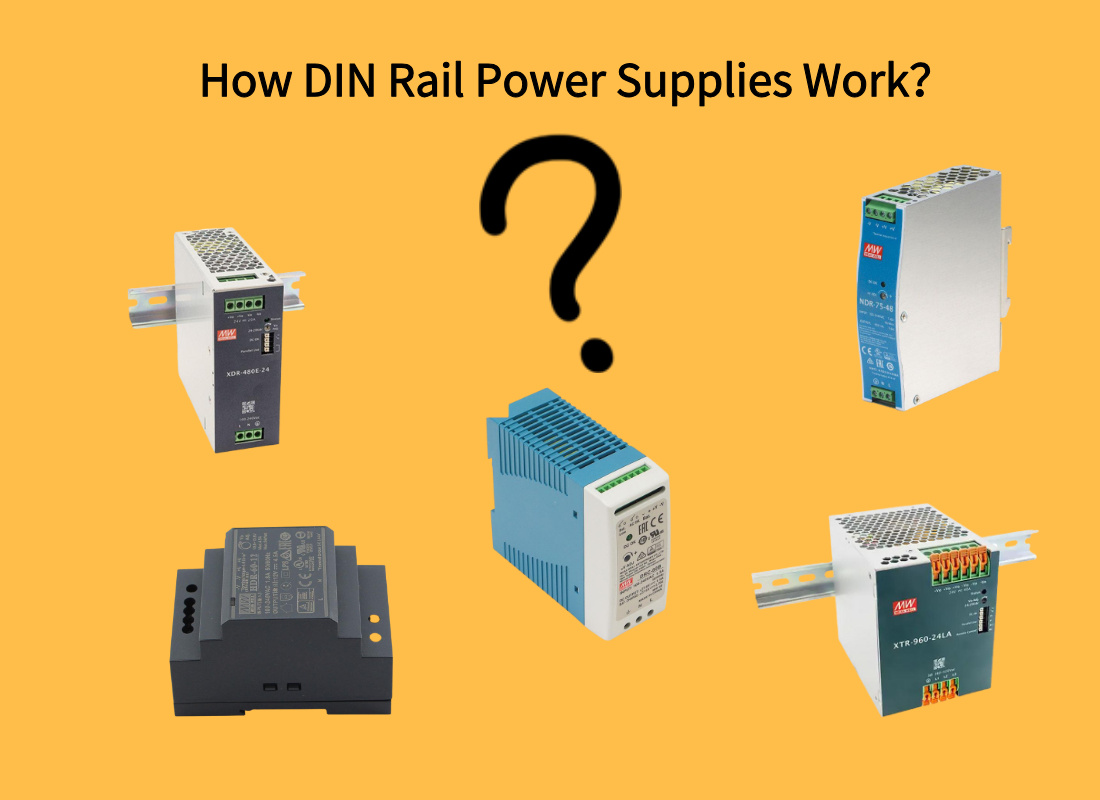
How DIN Rail Power Supplies Work: The Unsung Heroes of Industrial Automation
In the world of industrial control panels and automation systems, a crucial component operates quietly behind the scenes, ensuring everything else functions properly. DIN rail power supplies are the backbone of modern industrial electronics, converting and delivering clean, reliable power to sensitive control systems. But how exactly do these compact, modular devices work?
The Core Mission: Conversion and Stabilization
At its essence, a DIN rail power supply performs a fundamental task: converting available AC line voltage (typically 100-240V AC) into a regulated, low-voltage DC output (commonly 12V, 24V, or 48V DC). This process powers PLCs (Programmable Logic Controllers), sensors, relays, communication modules, and other critical devices that form the nervous system of industrial machinery.
Step-by-Step: The Power Conversion Journey
1. AC Input and Initial Filtering
The process begins when AC line voltage enters the power supply through its input terminals. Immediately, EMI/RFI filters remove high-frequency noise and electrical disturbances that could interfere with operation. This protects both the power supply and the connected equipment from line transients and surges.
2. Rectification: AC to DC
The filtered AC voltage passes through a bridge rectifier, which converts the alternating current into a pulsating direct current. This stage essentially flips the negative portions of the AC sine wave to positive, creating an uneven DC voltage that still requires significant smoothing.
3. Smoothing and Primary Storage
The pulsating DC flows into large electrolytic capacitors that act as reservoirs, storing energy during voltage peaks and releasing it during troughs. This significantly smooths the waveform, though some “ripple” voltage typically remains at this stage.
4. The Heart: High-Frequency Switching
Modern DIN rail power supplies primarily use switch-mode technology, which revolutionized power supply efficiency and size. Here’s how it works:
- A high-frequency oscillator (typically operating at 20-500 kHz) rapidly switches the DC voltage on and off.
- This switching action passes through a high-frequency transformer, which steps down the voltage to the desired output level.
- The high frequency allows for much smaller, lighter transformers compared to traditional linear designs.
5. Output Rectification and Filtering
The stepped-down, high-frequency AC from the transformer is rectified again (using fast-recovery diodes) back to DC. Additional LC filters (inductors and capacitors) then remove remaining high-frequency ripple, resulting in a clean, stable DC output.
6. Regulation and Control
A feedback control circuit continuously monitors the output voltage. If it detects any deviation from the set value (e.g., 24V DC), it instantly adjusts the switching duty cycle to compensate. This closed-loop system maintains stable output despite fluctuations in input voltage or changes in load demand.
7. Protection and Interface
Modern DIN rail power supplies incorporate multiple protection features:
- Overcurrent protection limits output current to prevent damage
- Overvoltage protection shuts down the unit if output voltage exceeds safe limits
- Thermal protection disables operation if internal temperatures rise too high
- Short-circuit protection allows the supply to withstand output shorts
Visual indicators (LEDs) show operational status, while terminal blocks or connectors provide easy wiring access.
Key Advantages of the DIN Rail Format
The standardized 35mm DIN rail mounting isn’t just convenient—it enables systematic, space-efficient panel design. These power supplies slide on and snap into place alongside other DIN-rail mounted components like circuit breakers, I/O modules, and terminal blocks, creating organized, serviceable control systems.
Beyond Basic Conversion: Specialized Functions
Advanced DIN rail power supplies offer additional capabilities:
- Buffer modules with built-in capacitors bridge brief power interruptions
- Redundant systems with parallel operation and diode isolation ensure uninterrupted power
- Medical and safety-rated units with enhanced isolation for critical applications
- Three-phase input models for higher power industrial applications
Applications: Where They Make a Difference
You’ll find DIN rail power supplies in virtually every industrial sector:
- Manufacturing – Powering robotic cells, conveyor controls, and assembly stations
- Process Control – Running instrumentation in chemical, food, and pharmaceutical plants
- Building Automation – Supplying HVAC controls, lighting systems, and access control
- Infrastructure – Operating water treatment systems, traffic controls, and telecommunications
Conclusion: The Reliable Workhorse
DIN rail power supplies exemplify engineering elegance through their efficient, reliable operation. By transforming raw, variable line power into precision-controlled DC voltage, they enable the sophisticated automation systems that drive modern industry. Their modular design, robust protection, and standardized format make them indispensable components in any control panel—true unsung heroes performing vital work, one conversion cycle at a time.
Looking for the right DIN rail power supply for your application? Consider your voltage and current requirements, environmental conditions, and any needed certifications. When properly selected and installed, these devices provide years of trouble-free operation, forming the reliable power foundation your control systems depend on.

Sobre el autor

Puestos relacionados

Choosing the right voltage for your power supply is a critical decision that affects performance, safety, and longevity of your electronic systems. While it may... Seguir leyendo
Power isn’t just an afterthought for your robot—it’s its lifeblood. Selecting the correct battery charger and power cord is one of the most critical, yet... Seguir leyendo
A high-performance CPU, a powerful GPU, fast storage—these are the components that capture our attention when building or upgrading a system. Yet, the component that... Seguir leyendo
In the vast landscape of industrial automation, we often celebrate the “brains” of the operation—the controllers and computers that make decisions. However, the true “muscle”... Seguir leyendo
If you’ve ever wondered what keeps modern factories running smoothly, the answer is simple: Programmable Logic Controllers (PLCs) . These rugged industrial computers have been the foundation... Seguir leyendo





Añadir un comentario