
No hay productos en la cesta.











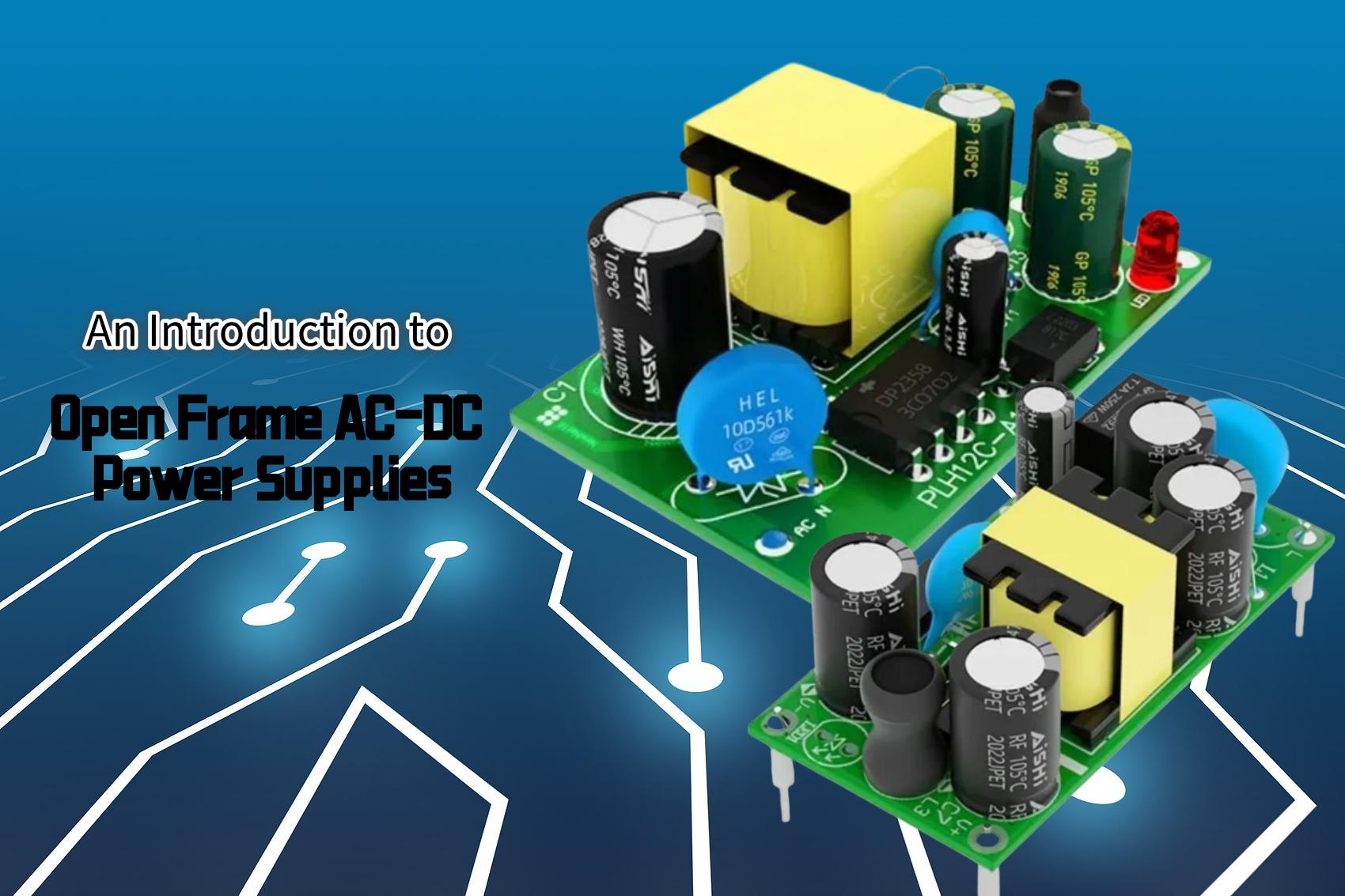
Introducción a las fuentes de alimentación CA-CC de bastidor abierto
In the world of electronics, delivering reliable power is the foundation of any successful design. Among the various power supply formats available, the open frame AC-DC power supply stands out as a versatile and widely adopted solution for integrating power conversion directly into larger systems.
This article serves as a foundational guide to open frame power supplies, explaining what they are, their key advantages and considerations, typical applications, and what to look for when selecting one.
What is an Open Frame Power Supply?
An open frame AC-DC power supply is a type of switched-mode power supply (SMPS) that is provided without a full external metal enclosure. Instead, its core components—the printed circuit board (PCB), transformers, heatsinks, and capacitors—are mounted on a metal chassis or tray, leaving the circuitry partially exposed.
Think of it as the “internal engine” of a power system. It is designed to be integrated as a component within a host equipment’s final enclosure, such as a medical device, industrial computer, or telecommunications rack. This is in contrast to enclosed or box-type power supplies, which are self-contained units with their own protective covers and are often used as standalone external adapters.
Visual Identification: You can typically recognize an open frame supply by its visible PCB components, aluminum U-channel or L-shaped baseplate for structural support and heatsinking, and screw terminals or connectors for input/output wiring.
Core Advantages: Why Choose an Open Frame Design?
The open architecture offers several compelling benefits for system integrators and designers:
- Cost-Effectiveness: By eliminating the standalone enclosure and associated assembly, open frame units are generally more economical than their enclosed counterparts. This makes them ideal for cost-sensitive, high-volume applications.
- Space Efficiency & Flexible Integration: Their compact, low-profile form factor allows for efficient use of space within the end equipment. Designers have the freedom to mount them in optimal locations for airflow or cable routing, maximizing the use of the overall system chassis.
- Superior Thermal Performance: The exposed design, combined with an integrated metal baseplate, facilitates direct heatsinking. The unit can be mounted to the system’s main chassis or an external heatsink, using the larger metal mass to efficiently dissipate heat, which improves reliability and longevity.
- Design Flexibility: The absence of a fixed enclosure allows for more flexible mechanical mounting (horizontal or vertical) and easier customization of cooling strategies (e.g., adding a system fan for directed airflow).
- Streamlined Compliance: Reputable manufacturers design and certify their open frame modules to meet essential international safety (e.g., IEC/UL 62368-1), EMI, and performance standards. This allows system designers to leverage pre-certified power components, significantly simplifying the overall compliance process for their end product.
Key Considerations and Potential Challenges
While advantageous, the open frame design also introduces specific considerations that must be addressed during system integration:
- Requires an End-Product Enclosure: The host equipment must provide a protective enclosure to prevent accidental contact with live parts, protect the supply from physical damage, and contain electromagnetic interference (EMI).
- Careful System-Level Design: The integrator is responsible for ensuring:
- Adequate Ventilation: Proper airflow must be provided within the end system to prevent overheating.
- EMI Management: The system’s enclosure must maintain the shielding integrity to contain any EMI generated by the power supply.
- Safety & Creepage/Clearance: The installation must maintain the mandated safety distances (creepage and clearance) between the open frame supply and other system components or the user-accessible parts.
- Exposure to Contaminants: In dusty or dirty environments, the exposed PCB may be more susceptible to contamination. The end-system enclosure must provide an adequate level of ingress protection (IP rating) if needed.
Typical Applications
Open frame power supplies are the workhorses of embedded electronics, found wherever reliable, integrated power is needed:
- Industrial Automation: PLCs, motor drives, HMI panels, and control systems.
- IT & Telecommunications: Servers, routers, switches, and network storage devices.
- Test & Measurement Equipment: Benchtop instruments, data acquisition systems.
- Medical Devices (using specially certified medical-grade models): Diagnostic equipment, dental tools, patient monitors.
- Office & POS Equipment: Printers, scanners, kiosks, and cash registers.
Selecting an Open Frame Power Supply: Key Parameters
When choosing a unit, look beyond just output voltage and current:
- Safety Certifications: Ensure it carries the necessary marks for your target market (e.g., UL, CE, CB report, with medical 60601-1 or industrial 61010-1 if required).
- Input Voltage Range: Confirm it supports your local AC mains voltage (e.g., 85-264 VAC universal input).
- Efficiency & Thermal Performance: Higher efficiency (>90%) means less wasted heat. Check the derating curve to see how much power it can deliver at your system’s maximum operating temperature.
- Physical Size & Mounting: Verify the mechanical dimensions and mounting hole pattern fit your layout.
- Características: Consider needed features like Power Factor Correction (PFC) for higher-power units, remote on/off control, or redundant operation capability.
Conclusion
Open frame AC-DC power supplies offer an optimal blend of performance, cost savings, and integration flexibility for a vast array of electronic equipment. By understanding their core concept—as a high-quality, pre-certified power component rather than a finished product—designers can effectively leverage them to build more compact, reliable, and competitive systems.
Successful implementation hinges on thoughtful system-level design that addresses cooling, safety, and EMI within the final product’s enclosure. When these factors are accounted for, the open frame power supply becomes an indispensable building block in modern electronic design.
Sobre el autor

Puestos relacionados

Choosing the right voltage for your power supply is a critical decision that affects performance, safety, and longevity of your electronic systems. While it may... Seguir leyendo

Power isn’t just an afterthought for your robot—it’s its lifeblood. Selecting the correct battery charger and power cord is one of the most critical, yet... Seguir leyendo

A high-performance CPU, a powerful GPU, fast storage—these are the components that capture our attention when building or upgrading a system. Yet, the component that... Seguir leyendo

In the vast landscape of industrial automation, we often celebrate the “brains” of the operation—the controllers and computers that make decisions. However, the true “muscle”... Seguir leyendo

If you’ve ever wondered what keeps modern factories running smoothly, the answer is simple: Programmable Logic Controllers (PLCs) . These rugged industrial computers have been the foundation... Seguir leyendo







Añadir un comentario