











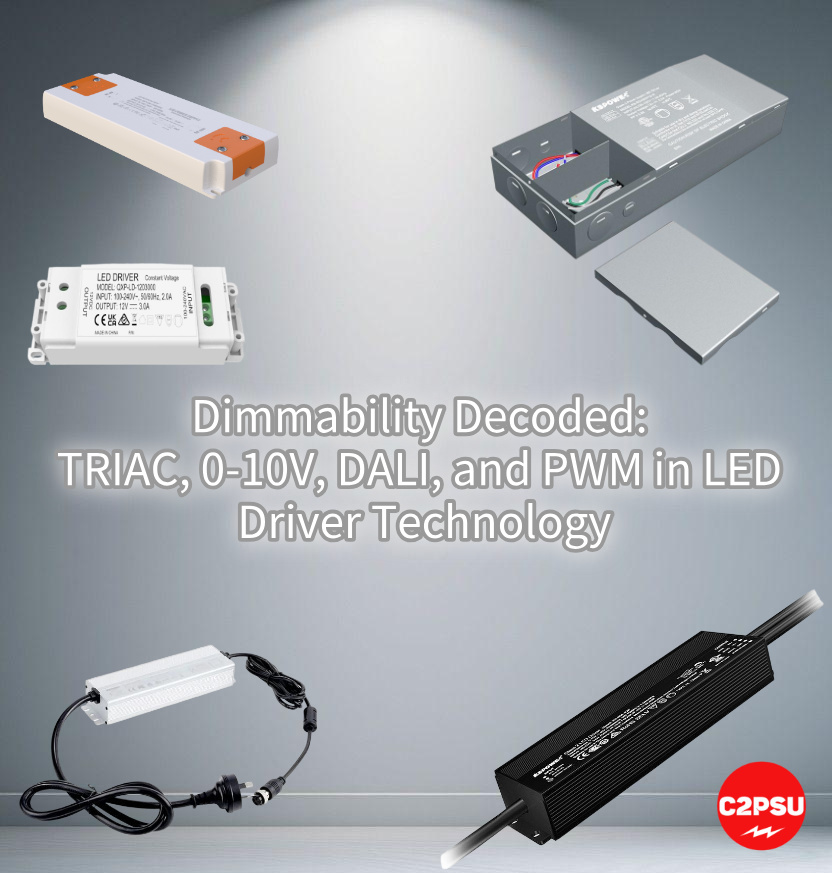
Dimmability Decoded: TRIAC, 0-10V, DALI, and PWM in LED Driver Technology
Lighting is no longer just about illumination—it’s about atmosphere, efficiency, and control. At the heart of this controllability is dimmability, enabled by the LED driver. But with terms like TRIAC, 0-10V, DALI, and PWM frequently mentioned, choosing the right dimming method can seem like navigating a maze.
This guide decodes the four most prevalent dimming protocols in LED driver technology, explaining how they work, their key applications, and how to select the right one for your project.
The Foundation: What is an LED Driver and Why Does Dimming Matter?
An LED driver regulates power to an LED light source. Unlike simple on/off switches, a dimmable LED driver interprets a control signal to precisely adjust the light output. Proper dimming extends LED lifespan, reduces energy consumption, and enables dynamic lighting scenes for comfort and productivity.
Protocol 1: TRIAC (Forward Phase-Cut) Dimming
- How It Works: TRIAC is the legacy technology adapted from incandescent dimming. It works by “chopping” out parts of the incoming AC voltage sine wave to reduce the total power delivered. The driver detects this chopped waveform and adjusts the LED current accordingly.
- Pros:
- High Compatibility: Uses standard wall dimmers installed in millions of homes and buildings.
- Familiar & Simple: Users are accustomed to the traditional rotary or slide dimmer.
- Cons:
- Flicker Risk: Can cause flickering at low levels if not matched with a high-compatibility driver.
- Limited Range & Performance: Often has a restricted dimming range (e.g., 20-100%) and may not dim as smoothly as other methods.
- Load Limitations: Requires a minimum load, which can be challenging with a few, highly efficient LEDs.
- Best For: Residential retrofits, commercial spaces with existing phase-cut dimmer infrastructure, and simple cost-sensitive applications.
Protocol 2: 0-10V Dimming
- How It Works: This is an analog protocol. A separate low-voltage control circuit sends a DC voltage signal between 0 and 10 volts to the driver. At 10V, the light is at 100%; at 1V (or 0.5V, depending on the driver), it is at minimum. The ballast or driver powers the LED load.
- Pros:
- Excellent Performance: Generally offers a wide, smooth dimming range down to 1% or lower.
- Simple Standard: Well-established in commercial lighting; easy to understand and implement.
- Cons:
- Extra Wiring: Requires two additional control wires alongside the mains power.
- No Bidirectional Communication: The control signal goes one way. The controller doesn’t receive status feedback from the fixture.
- Best For: Commercial and industrial applications (offices, warehouses), where reliable, smooth dimming is prioritized, and running extra wires is acceptable.
Protocol 3: DALI (Digital Addressable Lighting Interface)
- How It Works: DALI is a digital, two-way communication protocol. Each driver has a unique address and communicates with controllers and sensors over a dedicated low-voltage bus (two wires). Commands are sent digitally, allowing for individual or group control, scene setting, and querying of fixture status.
- Pros:
- Unmatched Control & Intelligence: Control individual lights, create groups, store lighting scenes, and integrate with building management systems (BMS).
- Status Feedback: The system can report failures, energy consumption, and operating hours for predictive maintenance.
- Standardized & Future-Proof: An open, global IEC standard ensuring interoperability.
- Cons:
- Higher Cost: More expensive drivers and requires a dedicated control system.
- Installation Complexity: Requires trained installers for programming and addressing.
- Best For: Advanced commercial projects (corporate offices, hotels, museums), new construction, and any application requiring intelligent, networked lighting control with data feedback.
Protocol 4: PWM (Pulse Width Modulation) Dimming
- How It Works: PWM is a direct drive-level technique, often used within the driver itself or for specialized applications. Instead of lowering the current, it rapidly switches the LED on and off at full current. The perceived brightness is controlled by the ratio of “on” time to “off” time (the duty cycle). A 50% duty cycle appears as 50% brightness.
- Pros:
- Precision & Consistency: Maintains consistent LED color (chromaticity) across the dimming range, which is crucial for RGB color mixing.
- Wide Range: Can achieve extremely deep dimming levels.
- Cons:
- Potential for Flicker: If the switching frequency is too low (<200Hz), visible flicker can occur.
- Typically a Sub-Protocol: Often used as the internal method a driver employs after receiving an external signal (like 0-10V or DALI). Dedicated PWM control wires are less common for general lighting.
- Best For: High-performance architectural lighting, RGB color-changing systems, signage, and applications where precise color control is paramount.
Choosing the Right Protocol: A Quick Comparison Guide
| Feature | TRIAC | 0-10V | DALI | PWM (Direct) |
|---|---|---|---|---|
| Signal Type | Analog (AC Chopping) | Analog (DC Voltage) | Digital | Digital (Pulse Train) |
| Wiring | 2-Wire (Line/Neutral) | 4-Wire (Power + Control) | 4-Wire (Power + Bus) | Varies |
| Communication | One-Way | One-Way | Two-Way | One-Way |
| Control Scope | Group/Zone | Group/Zone | Individual & Group | Group/Zone |
| Typical Best Use | Residential Retrofit | General Commercial | Intelligent Commercial/Architectural | Color-Critical & Specialty |
| Relative Cost | $ | $$ | $$$ | $$ |
Conclusion
There is no single “best” dimming protocol—only the best for your specific application. The choice depends on your project’s requirements for cost, complexity, control granularity, and future scalability.
- Choose TRIAC for simplicity and retrofits.
- Choose 0-10V for reliable, smooth commercial dimming.
- Choose DALI for intelligent, data-rich lighting systems.
- Choose PWM-based solutions for color-critical or high-precision applications.
Understanding these core technologies empowers you to specify lighting systems that deliver not just light, but the exact performance, experience, and efficiency you envision.
Ready to specify the perfect dimming solution? [Explore our full range of dimmable LED drivers, featuring compatibility with TRIAC, 0-10V, DALI, and more, or contact our technical support team for expert guidance.]
About author











Add comment