











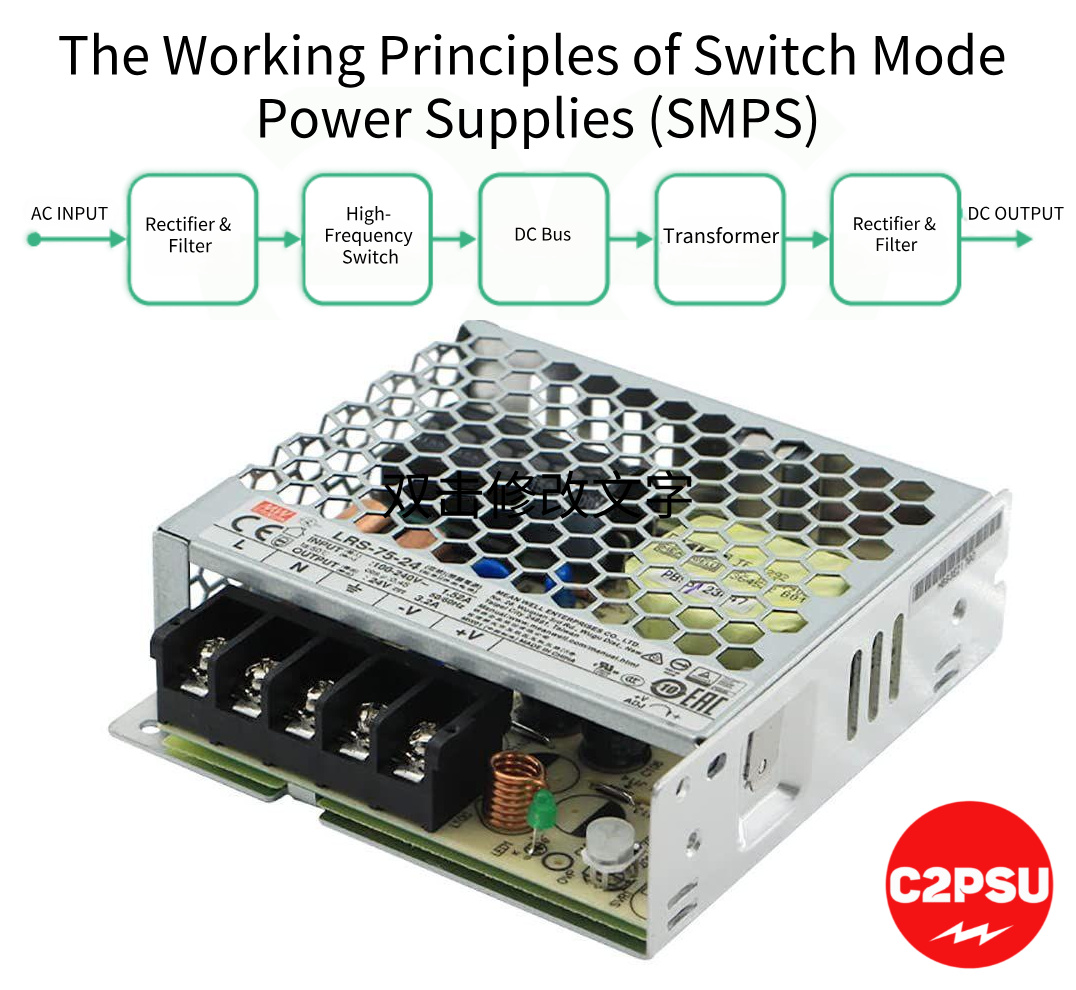
The Working Principles of Switch Mode Power Supplies (SMPS)
Introduction: The Efficiency Revolution
In the world of power conversion, Switch Mode Power Supplies (SMPS) represent a fundamental technological leap. While traditional linear power supplies have their place, SMPS technology powers the vast majority of modern electronics—from smartphone chargers and laptops to servers and industrial equipment. Why this dominance? The answer lies in one word: efficiency.
Where linear regulators might waste 40-60% of input power as heat, SMPS typically achieve 70-95% efficiency. This article explores the working principles that make this remarkable efficiency possible.
The Core Concept: Trading Heat for Frequency
The fundamental innovation of SMPS is simple yet profound: Instead of dissipating excess power as heat (like linear regulators), SMPS rapidly switch power on and off, controlling energy delivery through timing rather than resistance.
Think of it this way:
- Linear power supply: Like regulating water flow with a valve that constricts the pipe (creating heat/friction)
- Switch mode power supply: Like using a fast-acting on/off valve that pulses open and closed, with the average flow determined by pulse timing
Basic SMPS Block Diagram
Every SMPS contains these essential elements:
AC Input → [Rectifier & Filter] → DC Bus → [High-Frequency Switch] → [Transformer] → [Rectifier & Filter] → DC Output
                                              ↑
                                     [Controller & Feedback]
The Four Fundamental Stages of SMPS Operation
Stage 1: Input Rectification and Filtering
Objetivo: Convert AC input to rough DC
Como funciona:
- Rectification: Diodes convert AC to pulsating DC
- Filtragem: Large capacitors smooth the pulsations into relatively stable DC
- Result: Creates the DC bus voltage (e.g., ~325V DC from 230V AC)
Key point: This initial stage is identical to traditional power supplies and represents one of the SMPS’s few efficiency losses.
Stage 2: High-Frequency Switching
Objetivo: Chop the DC bus into high-frequency pulses
Como funciona:
- A semiconductor switch (MOSFET) turns on and off at high frequency (typically 50kHz to 1MHz+)
- When ON: Current flows from DC bus through the switch
- When OFF: Current flow stops completely
- The ratio of ON-time to total period is called ciclo de trabalho
The switching secret: Because the switch is either fully ON (low resistance) or fully OFF (no current), very little power is dissipated in the switch itself. This is the primary source of SMPS efficiency.
Switching frequency trade-offs:
- Higher frequency: Smaller transformers and filters, but increased switching losses
- Lower frequency: Reduced switching losses, but larger, heavier magnetic components
Stage 3: Energy Transfer and Transformation
Objetivo: Transfer and convert the pulsed energy to the desired output
Como funciona:
- The switching pulses drive a transformer (in isolated designs) or inductor (in non-isolated designs)
- During switch ON-time: Energy builds in the magnetic field
- During switch OFF-time: Energy transfers to the output
- The transformer provides voltage scaling and electrical isolation
Key insight: Magnetic components store energy temporarily rather than dissipating it, making the process inherently efficient.
Stage 4: Output Rectification and Filtering
Objetivo: Convert the transformed pulses to stable DC output
Como funciona:
- Rectification: Diodes convert high-frequency AC to DC pulses
- Filtragem: Inductors and capacitors smooth the pulses into clean DC
- Feedback: A small portion of output voltage is compared to a reference
The feedback loop: Any difference between actual and desired output adjusts the switching duty cycle, maintaining stable output despite input or load changes.
Topology Variations: Different Paths to Efficiency
SMPS come in several configurations, each optimized for specific applications:
1. Buck (Step-Down) Converter
- Function: Output voltage is lower than input voltage
- Key characteristic: Simple, non-isolated, extremely common
- Typical use: DC-DC conversion in computers, regulators on circuit boards
- Eficiência: Often 85-95%
2. Boost (Step-Up) Converter
- Function: Output voltage is higher than input voltage
- Key characteristic: Can theoretically produce unlimited voltage (practically limited by components)
- Typical use: Battery-powered devices, LED drivers, power factor correction
- Eficiência: Typically 80-90%
3. Buck-Boost Converter
- Function: Output voltage can be either higher or lower than input
- Key characteristic: Output polarity is inverted
- Typical use: Battery systems where voltage varies above and below required level
- Eficiência: Slightly lower than buck or boost alone
4. Flyback Converter
- Function: Isolated conversion, can step up or down
- Key characteristic: Simple, cost-effective isolation
- Typical use: Low-to-medium power AC-DC adapters (phone chargers)
- Eficiência: Typically 70-85%
5. Forward Converter
- Function: Isolated conversion, direct energy transfer
- Key characteristic: Better transformer utilization than flyback
- Typical use: Medium power applications (50-500W)
- Eficiência: Typically 80-90%
6. Push-Pull, Half-Bridge, and Full-Bridge Converters
- Function: High-power isolated conversion
- Key characteristic: Excellent power handling, more complex
- Typical use: Server power supplies, industrial equipment, welding supplies
- Eficiência: Can exceed 90% at high power levels
Key Components: The SMPS Building Blocks
Switching Elements
- MOSFETs: Most common for frequencies up to ~500kHz
- IGBTs: Used in high-voltage, lower-frequency applications
- GaN/SiC transistors: Emerging technologies for ultra-high efficiency and frequency
Magnetic Components
- Transformadores: Provide isolation and voltage scaling
- Inductors: Store and transfer energy, filter output
- Design challenge: Must handle high frequencies without excessive losses
Control ICs
- Modern SMPS are governed by sophisticated controllers that:
- Set switching frequency
- Implement pulse-width modulation (PWM)
- Provide protection features (over-current, over-temperature)
- Manage soft-start to limit inrush current
The Physics Behind the Efficiency
Why Switching Reduces Losses
- Conduction Losses: Only during ON-state Pconduction=I2×RDS(on)
- Switching Losses: Brief periods during transitions Pswitching∝frequency×transition time×voltage×current
- Gate Drive Losses: Energy required to switch the MOSFET gate
Thermal Advantages
Because less energy is wasted as heat:
- Smaller heat sinks or sometimes none at all
- Higher power density (more watts per cubic inch)
- Improved reliability due to lower operating temperatures
Practical Considerations and Challenges
Electromagnetic Interference (EMI)
The rapid switching creates high-frequency noise that must be controlled through:
- Input filters: Reduce noise fed back to AC line
- Shielding: Contain radiated emissions
- Careful layout: Minimize loop areas and parasitic effects
Power Factor
Simple SMPS can have poor power factor, but modern designs often include:
- Active PFC: Additional switching stage to align current with voltage
- Passive PFC: Simpler, less effective correction
Complexity vs. Reliability
While more complex than linear supplies, modern SMPS achieve excellent reliability through:
- Integrated protection (OVP, OCP, OTP, SCP)
- Robust component selection
- Advanced thermal management
Real-World Applications
Eletrónica de consumo
Your smartphone charger is almost certainly a flyback converter, chosen for its excellent compromise of cost, size, and isolation.
Informática
Computer power supplies typically use multiple stages: PFC boost converter followed by isolated DC-DC converters (often LLC resonant or forward converters) for different voltage rails.
LED Lighting
LED drivers frequently use buck or boost converters optimized for constant current output rather than constant voltage.
Automóvel
Electric vehicle power systems employ sophisticated SMPS for traction motor control, battery management, and accessory power.
The Future of Switching Technology
Higher Frequencies
With GaN and SiC devices, switching frequencies are pushing into the MHz range, enabling:
- Dramatically smaller magnetic components
- Even higher efficiency
- Faster transient response
Digital Control
Microcontroller-based SMPS offer:
- Programmable characteristics
- Advanced control algorithms
- Communication and monitoring capabilities
Integration
Power System-in-Package (PSiP) and Power System-on-Chip (PSoC) technologies are integrating more functions into single packages.
Conclusion: The Switching Paradigm
Switch Mode Power Supplies represent a perfect example of engineering elegance—turning a potential problem (switching losses) into the key advantage. By operating components in their most efficient states (fully ON or fully OFF) and using magnetic storage to transfer energy rather than dissipate it, SMPS deliver the compact, efficient, and versatile power conversion that modern electronics demand.
Understanding these principles illuminates not just how your devices get power, but why they’ve become smaller, more powerful, and more energy-efficient over time. As switching technology continues to advance, we can expect even greater efficiency breakthroughs that will power the next generation of electronic innovation.
Technical Note: This article covers fundamental SMPS principles. Actual design requires careful consideration of safety standards (isolation, creepage, clearance), regulatory requirements (EMI, efficiency standards), and application-specific constraints.
About author








Add comment