











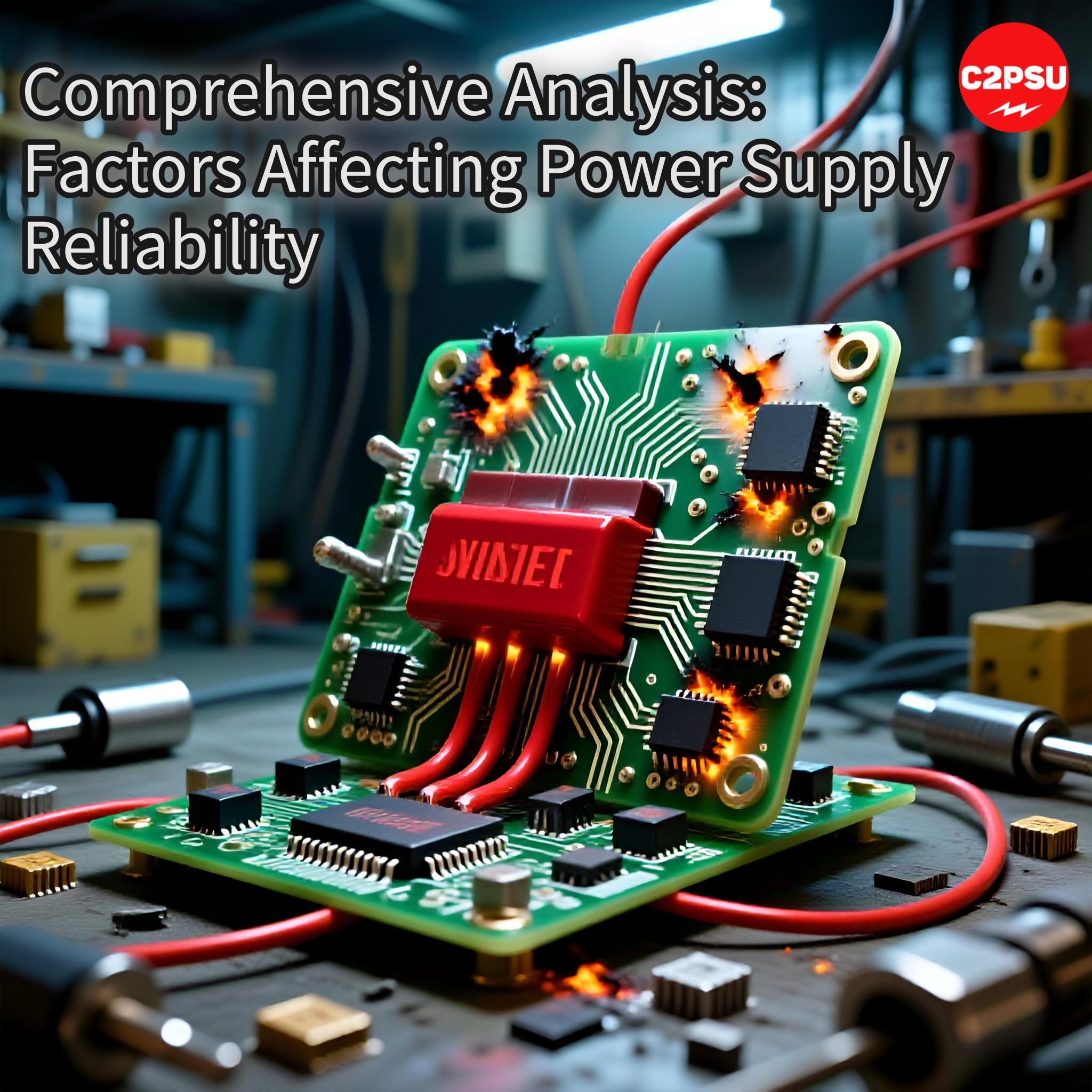
Comprehensive Analysis: Factors Affecting Power Supply Reliability
1. Component Selection & Quality
A. Critical Component Hierarchy
O reliability bathtub curve applies strongly to power supplies, with different components dominating different failure phases:
| Component | Early Failures | Random Failures | Wear-Out Failures |
|---|---|---|---|
| Electrolytic Capacitors | Low | Moderate | PRIMARY (>60%) |
| Semiconductors (MOSFETs, Diodes) | HIGH | Moderate | Moderate |
| Magnetic Components | Moderate | Low | Low (unless overheated) |
| Resistors/Ceramics | Low | Muito baixo | Muito baixo |
| Connectors/Sockets | Moderate | Low | HIGH (mechanical wear) |
B. Derating Practices
Component derating is the single most effective design practice for reliability:
| Component | Recommended Derating | Impact on Reliability |
|---|---|---|
| Electrolytic Capacitors | Voltage: ≤80% rating Temperature: 20°C below max Ripple Current: ≤75% rating | 3-10× lifetime improvement |
| MOSFETs/Transistors | Vds: ≤80% rating Current: ≤60% rating Junction Temp: ≤110°C | 5× reduction in failure rate |
| Diodes | Reverse Voltage: ≤75% rating Forward Current: ≤50% rating | 4× improvement |
| Transformers/Inductors | Core Flux: ≤75% saturation Current Density: ≤400 A/cm² | Prevents thermal runaway |
| Resistors | Power: ≤50% rating | Eliminates thermal drift |
2. Thermal Management
A. Temperature Effects (Arrhenius Law)
For every 10°C rise in temperature, failure rates approximately double for most electronic components:
Reliability ∝ 2^[(Tmax - Tactual)/10]
B. Hotspot Identification & Control
- Worst-case components: MOSFETs, output rectifiers, transformers
- Critical thermal interfaces: Heatsink-to-component, PCB-to-air
- Temperature monitoring points: Transformer core, capacitor can, semiconductor case
C. Cooling Strategy Effectiveness
| Method | ΔT Reduction | Reliability Improvement |
|---|---|---|
| Natural convection | Baseline | 1× |
| Forced air (1 m/s) | 20-30°C | 4-8× lifetime |
| Heat pipes | 30-50°C | 8-32× lifetime |
| Liquid cooling | 40-60°C | 16-64× lifetime |
3. Electrical Stress Factors
A. Input Stressors
- Line Transients (IEC 61000-4-5)
- Lightning surges: ±1-4kV
- Switching surges: ±500V
- Protection: MOVs, TVS diodes, gas discharge tubes
- Voltage Variations
- Brownouts (80% nominal) cause overcurrent
- Overvoltage (120% nominal) causes overstress
- Solução: Wide input range (85-265VAC) designs
B. Load Stressors
- Corrente de irrupção
- Cold start: 10-100× steady state
- Mitigation: NTC thermistors, active limiting circuits
- Load Transients
- Step changes: 10-90% load in microseconds
- Requirement: Proper control loop bandwidth and output capacitance
- Output Short Circuits
- Foldback vs. constant current protection
- Critical: Auto-recovery capability without latch-up
4. Environmental Factors
A. Humidity & Contamination
| Environment | Failure Rate Multiplier | Primary Mechanisms |
|---|---|---|
| Office (40-60% RH) | 1× | Minimal |
| Tropical (>80% RH) | 3-5× | Corrosion, electrochemical migration |
| Industrial (contaminants) | 5-10× | Conductive dust, sulfur corrosion |
| Marine (salt spray) | 10-20× | Rapid corrosion, insulation breakdown |
B. Mechanical Stress
- Vibration (especially for mounted components)
- Large capacitors, transformers require mechanical securing
- Resonant frequencies: Typically 100-500Hz for PCB assemblies
- Thermal Cycling
- CTE mismatches cause solder joint fatigue
- Accelerated by: Power cycling, ΔT > 40°C
5. Design & Topology Considerations
A. Topology Reliability Comparison
| Topology | Typical Efficiency | Component Count | Relative Reliability |
|---|---|---|---|
| Flyback | 80-90% | Low | HIGH (simple) |
| Forward | 82-92% | Moderate | Medium-High |
| LLC Resonant | 92-96% | Moderate | HIGH (soft-switching) |
| Phase-Shifted Full Bridge | 90-95% | High | Medium |
| Buck/Boost | 85-95% | Muito baixo | VERY HIGH |
B. Control Method Impact
- Voltage mode: Simpler, less noise-sensitive
- Current mode: Better transient response, inherent current limiting
- Digital control: Advanced protection, monitoring, but software reliability factors
6. Manufacturing & Process Factors
A. PCB Design & Assembly
| Factor | Reliability Impact | Best Practice |
|---|---|---|
| Copper Weight | Thermal management | 2-4 oz for power traces |
| Via Design | Thermal cycling fatigue | Filled vias under components |
| Solder Joint Quality | Early failures | IPC-A-610 Class 2/3 |
| Conformal Coating | Environmental protection | 50-100μm thickness |
B. Burn-in & Testing
- Early Failure Removal: 48-168 hour burn-in at elevated temperature
- HALT/HASS: Highly Accelerated Life/Stress Screening
- Production Testing: 100% functional test, partial load cycle test
7. Operational Factors
A. Load Profile
| Profile | Stress Factors | Reliability Impact |
|---|---|---|
| Continuous 100% | Thermal stress | Capacitor/electrolytic wear-out |
| Cyclical (0-100%) | Thermal cycling | Solder joint/mechanical fatigue |
| Pulsed (high di/dt) | Magnetic stress | Semiconductor SOA violations |
| Light Load (<20%) | Control instability | Potential oscillation |
B. Maintenance Practices
- Preventive
- Capacitor replacement at 50% of rated life
- Fan replacement at 30,000-50,000 hours
- Thermal interface material refresh
- Predictive
- ESR monitoring for capacitors
- Temperature trending
- Output ripple measurement
8. Standards & Compliance Impact
A. Safety Standards (IEC/EN/UL 62368-1)
- Clearance/Creepage distances: Prevent arcing
- Fault conditions testing: Single-fault safety
- Flammability requirements: V-0, 5VA materials
B. Environmental Standards
- RoHS compliance: Lead-free solder affects thermal cycling reliability
- REACH: Material restrictions affect component selection
9. Reliability Metrics & Prediction
A. MTBF Calculation
Typical power supply MTBF ranges:
- Consumer: 50,000-100,000 hours
- Industrial: 100,000-300,000 hours
- Military/Medical: 500,000+ hours
B. Accelerated Testing Correlations
AF = (Vstress/Vuse)^n × 2^[(Tstress-Tuse)/10]
Where:
- AF = Acceleration Factor
- n = Voltage exponent (3-5 for capacitors)
- T = Temperature in °C
10. Emerging Technologies & Trends
A. GaN/SiC Devices
- Higher efficiency → Lower temperatures
- Higher switching frequencies → Smaller magnetics
- Wider bandgap → Higher temperature capability
B. Digital Power Management
- Predictive maintenance through parameter monitoring
- Adaptive control for varying conditions
- Fault logging for root cause analysis
Practical Reliability Enhancement Checklist
Design Phase:
- Apply proper derating to all components
- Thermal simulation with worst-case scenarios
- Select components with proven reliability data
- Implement comprehensive protection circuits
Manufacturing Phase:
- Control soldering profiles (especially for large components)
- 100% electrical testing with stress conditions
- Burn-in for critical applications
- Conformal coating for harsh environments
Operational Phase:
- Ensure adequate ventilation/cooling
- Monitor key parameters (temperature, ripple)
- Implement preventive maintenance schedule
- Keep within specified operating envelope
Conclusion: The Reliability Hierarchy
From most to least impactful on power supply reliability:
- Temperature management (especially capacitor core temp)
- Component derating practices
- Input/output protection circuitry
- Manufacturing quality control
- Environmental sealing/protection
- Operational load profile
- Maintenance practices
A well-designed power supply implementing aggressive derating, robust thermal management, and comprehensive protection can achieve reliability that exceeds the system it powers, effectively making the power supply a non-issue for the product’s operational lifetime.
Key Takeaway: Reliability is not a single factor but a system property that must be designed in from the beginning. The most common field failures stem from thermal stress on electrolytic capacitors e transient voltage spikes on semiconductors—both of which are addressable through proper design practices.


About author












Add comment