










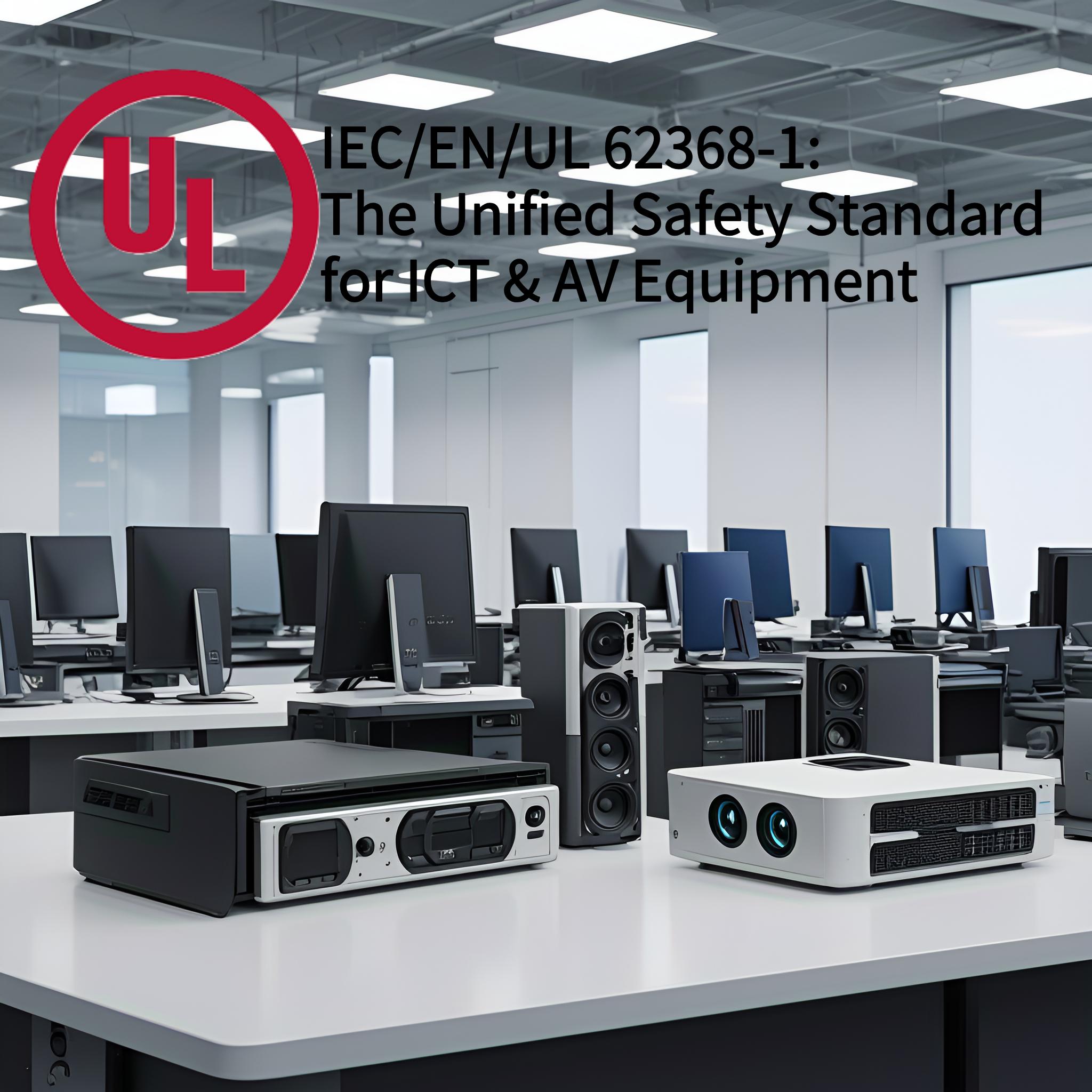
IEC/EN/UL 62368-1: The Unified Safety Standard for ICT & AV Equipment
What is IEC/EN/UL 62368-1?
IEC/EN/UL 62368-1 is a hazard-based safety engineering standard that applies to Information and Communication Technology (ICT) and Audio/Video (AV) equipment. It represents a fundamental shift from traditional prescriptive safety standards to a more flexible, performance-based approach centered on identifying and mitigating energy hazards.
Formally titled *”Audio/video, information and communication technology equipment – Part 1: Safety requirements,”* it has become the globally recognized safety benchmark for modern electronic devices.
The Transition from Old Standards
This standard is the direct successor to and eventual replacement for two long-standing legacy standards:
- IEC/EN/UL 60950-1: For IT equipment (e.g., computers, servers, routers).
- IEC/EN/UL 60065: For AV equipment (e.g., televisions, amplifiers, speakers).
The transition period has ended in most major markets, making IEC/EN/UL 62368-1 the mandatory standard for new product certifications.
Core Philosophy: Hazard-Based Safety Engineering (HBSE)
Unlike older “rules-based” standards that prescribed specific design solutions (e.g., “use a 1mm thick plastic barrier”), IEC 62368-1 is outcome-focused. It requires manufacturers to:
- Identify potential energy sources within the product (electrical, thermal, kinetic, chemical, radiation).
- Classify these energy sources based on their severity using a three-class system.
- Apply Safeguards to protect persons from injury by preventing energy transfer that exceeds body’s tolerance limits.
This approach is more adaptable to innovative and converging technologies, as it focuses on the inherent hazard rather than a predefined construction method.
The Three-Class Energy Source System
The foundation of the standard is the classification of energy sources:
| Class | Penerangan | Potential for Injury | Example Safeguard Principle |
|---|---|---|---|
| Class 1 (ES1) | Painless, non-injurious energy. | No injury. Touching is safe under normal and single-fault conditions. | No safeguard required. Basic insulation is often sufficient. |
| Class 2 (ES2) | Energy that can cause discomfort but is not likely to cause injury. May be painful (e.g., a shock), but won’t cause physical harm like burns or electric shock effects on the heart. | Normally no injury, but can cause involuntary reaction. | Basic Safeguards are required to protect Ordinary Persons. These prevent contact under normal operating conditions and after a single fault. |
| Class 3 (ES3) | Energy that can cause injury. This includes hazardous voltage levels, high temperatures, projectiles, etc. | Risk of permanent injury, burns, or electrocution. | Double or Reinforced Safeguards are required to protect Ordinary Persons dan Instructed Persons. These must remain effective even after two independent faults. |
Protection of Persons
The standard defines three types of persons, with requirements tailored to their expected skill and awareness:
- Ordinary Person: A general user with no special training. They are protected from Class 2 and Class 3 energy sources.
- Instructed Person: Someone aware of the hazards and instructed on how to avoid them (e.g., service personnel using a manual). They are protected from Class 3 energy sources.
- Skilled Person: A professional with specialized training (e.g., an electrician). The standard’s primary protections are not necessarily aimed at this group.
Key Technical Requirements & Common Test Criteria
The standard covers a wide range of safety aspects. Key areas include:
- Electric Shock Hazard: Defines limits for accessible parts (touch current, leakage current, peak voltage).
- Electrical Insulation: Specifies requirements for Basic, Supplementary, Double, and Reinforced Insulation based on the working voltage and energy class.
- Creepage & Clearance Distances: Critical spacing distances between conductive parts to prevent arcing and breakdown. These are determined by the Working Voltage, Pollution Degree, and Material Group (CTI).
- Energy Hazard Mitigation: Requirements for components like batteries (including Li-ion), capacitors, and motors to prevent fire, explosion, or ejection.
- Fire & Thermal Hazard: Enclosure flammability ratings (e.g., 5VA, V-0, HB), temperature limits for touchable parts, and prevention of overheating.
- Mechanical Hazards: Stability, sharp edges, moving parts, and strength of enclosures.
- Radiation: Includes laser safety and requirements for LED sources (addressing blue light hazard).
The Role of Component Standards
IEC 62368-1 relies heavily on the use of certified critical safety components. If a component (like a transformer, fuse, or optical coupler) is certified to its own relevant component standard (e.g., UL 1310 for Class 2 power units, IEC 61558 for transformers), it can often be used without further testing within its specified ratings.
Global Acceptance & Market Variations: IEC vs. EN vs. UL
The core technical content is identical, but the prefix indicates the issuing body and its associated national deviations or normative references.
- IEC 62368-1: The base international standard published by the International Electrotechnical Commission. Globally recognized as the technical foundation.
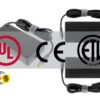
- EN 62368-1: The European version, published as a Harmonized Standard under the EU’s Low Voltage Directive (LVD) and Radio Equipment Directive (RED). Compliance provides presumption of conformity for the CE marking.
- UL 62368-1: The U.S. and Canadian version, published by Underwriters Laboratories. It includes specific Nationally Deviated Requirements (NDRs) to align with the National Electrical Code (NEC) and other North American regulations (e.g., fire enclosure requirements, specific wiring rules). A product certified to UL 62368-1 can carry the cULus mark for both the U.S. and Canada.
Why Compliance is Critical
- Legal Market Access: It is a mandatory requirement for selling ICT/AV equipment in the EU (CE mark), UK (UKCA mark), USA/Canada (cULus/NRTL mark), and many other countries.
- Product Liability & Risk Mitigation: Demonstrates due diligence in designing safe products, reducing legal and financial risks from incidents.
- Global Market Efficiency: Using a single, harmonized standard simplifies the certification process for multiple markets.
- Future-Proof Design: Its hazard-based approach accommodates new technologies more readily than old prescriptive standards.
Practical Steps for Compliance
- Early Design Integration: Incorporate HBSE principles from the initial concept phase. Perform a hazard analysis to classify energy sources.
- Select Pre-Certified Components: Use power supplies, connectors, and other critical components that are already certified to applicable standards.
- Pre-Compliance Testing: Work with a lab or consultant to identify and fix potential non-compliances before formal certification.
- Formal Certification: Engage with a Notified Body (for EU), Nationally Recognized Testing Laboratory (NRTL) like UL or Intertek (for US), or other accredited certification body for your target market.
- Documentation: Prepare the comprehensive technical file required by the standard and applicable directives/regulations.
Disclaimer: This guide provides an educational overview of IEC/EN/UL 62368-1. It is not a substitute for the full standard or professional compliance advice. Always consult the latest official version of the standard and engage with qualified safety engineering professionals or certification bodies for your specific product assessment.
About author





Add comment