











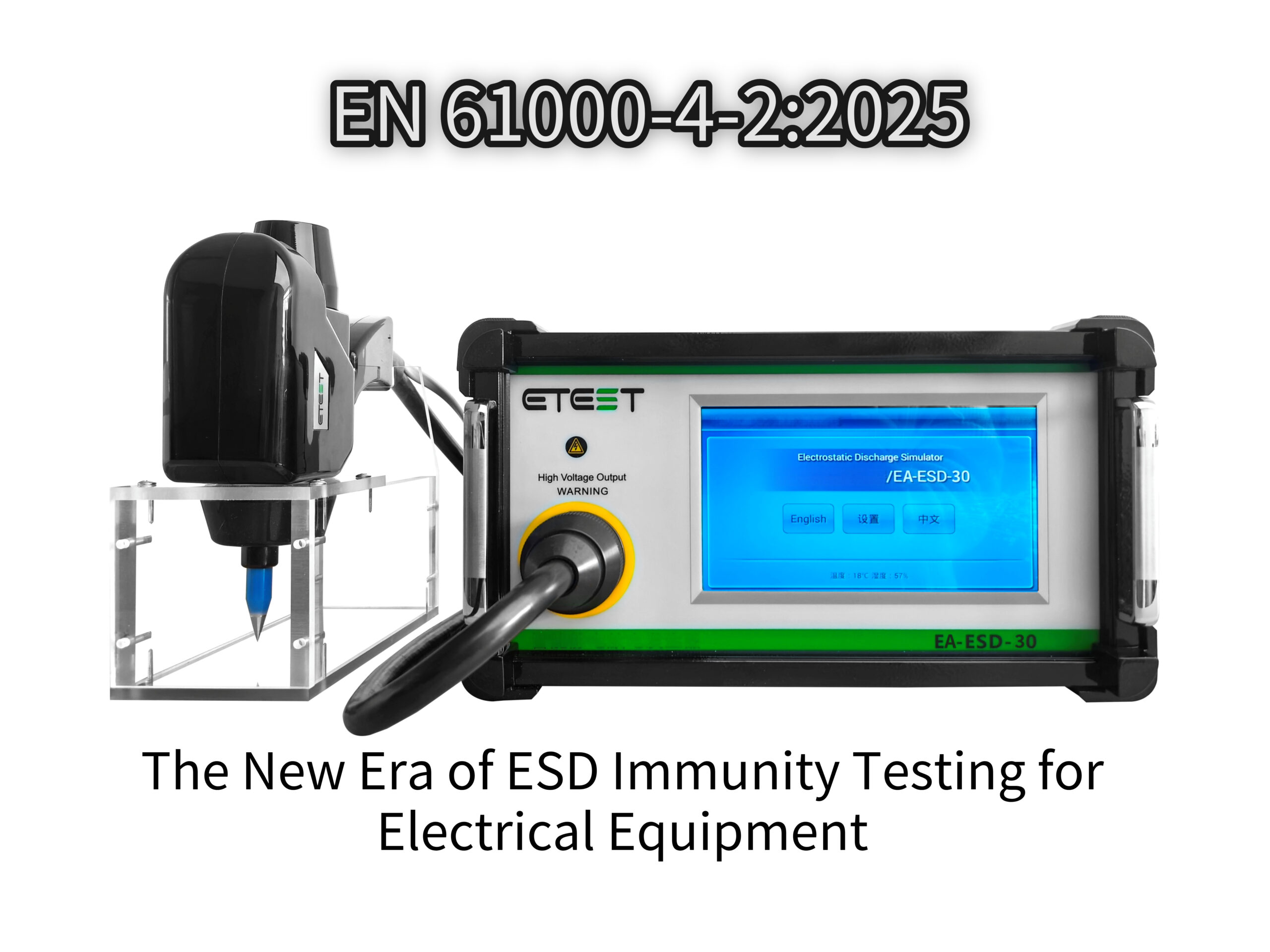
EN 61000-4-2:2025 – The New Era of ESD Immunity Testing for Electrical Equipment
As electrostatic discharge (ESD) events become increasingly consequential in our interconnected digital world, the European Committee for Electrotechnical Standardization (CENELEC) has published EN 61000-4-2:2025, representing a significant evolution in ESD testing requirements. This latest revision introduces critical updates that reflect modern technological realities and testing methodologies. At C2PSU, our engineering teams have already implemented these new requirements across our product development lifecycle, ensuring our power solutions exceed the most current immunity standards.
Understanding the Standard’s Evolution
EN 61000-4-2:2025 is the harmonized European version of IEC 61000-4-2:2024, establishing test and measurement techniques for evaluating equipment immunity to ESD events. This update replaces EN 61000-4-2:2009 and its amendments, incorporating sixteen years of technological advancement and field experience.
Key Transition Timeline:
- Previous Standard: EN 61000-4-2:2009 + A1:2010
- New Standard Effective: EN 61000-4-2:2025 published February 2025
- Transition Period: Typically 36 months from publication
- Manufacturer Action Required: Update testing protocols, documentation, and product designs
Major Technical Revisions and Updates
Enhanced Test Methodologies
1. Updated Contact Discharge Requirements
- Higher Voltage Ranges: Expanded testing up to 16.5 kV for specific environments
- Improved Waveform Verification: Stricter requirements for ESD generator calibration
- Repetition Rate Specifications: Clarified requirements for discharge intervals
2. Air Discharge Refinements
- Approach Speed Standardization: Defined approach speeds for different voltage levels
- Humidity Considerations: Enhanced guidance for environmental conditioning
- Electrode Geometry: Updated specifications for discharge electrodes
3. Direct vs. Indirect Application
- Direct Application: Enhanced requirements for equipment ports and accessible surfaces
- Indirect Application: Improved test methods for horizontal and vertical coupling planes
- Combined Testing: Guidance on simultaneous direct and indirect testing scenarios
New Test Severity Levels
The 2025 edition introduces revised severity levels reflecting real-world environments:
| Severity Level | Contact Discharge | Air Discharge | Typical Environment |
|---|---|---|---|
| Level 1 | 2 kV | 2 kV | Protected, controlled environments |
| Level 2 | 4 kV | 4 kV | Indoor environments with anti-static measures |
| Level 3 | 6 kV | 8 kV | Typical industrial and commercial spaces |
| Level 4 | 8 kV | 15 kV | Harsh industrial environments |
| Level X | Special | Special | Custom requirements per manufacturer |
Note: Level X now includes specific guidance for establishing custom test parameters based on intended use environments.
Critical Changes Impacting Equipment Design
Expanded Scope of Application
The new standard explicitly addresses:
- IoT and Connected Devices: Enhanced requirements for network-connected equipment
- Portable and Wearable Electronics: Specific test methodologies for mobile devices
- Medical Equipment: Clarified requirements for patient-connected devices
- Automotive Electronics: Cross-references to automotive-specific ESD standards
- Renewable Energy Systems: Guidance for solar and wind power equipment
Improved Test Setup Specifications
1. Ground Reference Plane (GRP) Requirements
- Enhanced specifications for GRP material and dimensions
- Updated placement requirements relative to equipment under test (EUT)
- Clarified connection methods to ensure consistent ground references
2. Tabletop vs. Floor-standing Equipment
- Refined differentiation between equipment types
- Updated height requirements for tabletop setups
- Enhanced guidance for large floor-standing systems
3. Cable Configuration and Routing
- Standardized cable lengths and routing methods
- Enhanced requirements for cable types and termination
- Improved guidance for testing equipment with multiple cable types
Performance Criteria Updates
The standard refines the four standard performance criteria:
- Criterion A: Normal performance within specification limits
- Criterion B: Temporary degradation or loss of function with self-recovery
- Criterion C: Temporary degradation requiring operator intervention
- Criterion D: Degradation not recoverable without repair
New Emphasis: Clearer definition of “temporary” timeframes and specific requirements for documenting recovery processes.
C2PSU’s Proactive Implementation Strategy
Advanced ESD Protection Architecture
Our power solutions incorporate multi-layer ESD protection designed to exceed 2025 requirements:
Primary Protection Layer
- Enhanced Input Filtering: Advanced common-mode and differential-mode filtering
- TVS Diode Arrays: Fast-response transient voltage suppressors at all external interfaces
- Enhanced Creepage/Clearance: Exceeds minimum requirements by 50-100%
Secondary Protection Layer
- Isolation Barriers: Reinforced isolation in critical signal and power paths
- Grounding Optimization: Low-impedance ground paths for effective charge dissipation
- Shielding Effectiveness: Improved enclosure shielding and cable screening
Tertiary Protection Layer
- Watchdog Circuits: Automatic recovery mechanisms after transient events
- Redundant Control Systems: Backup control paths for critical functions
- Self-Diagnostic Features: Automatic detection and reporting of ESD events
Pre-compliance Testing
- Early-stage design verification using calibrated ESD generators
- Systematic testing at all development milestones
- Environmental condition testing (-10°C to +40°C, 30-60% RH)
Formal Compliance Testing
- Testing at accredited laboratories using 2025 methodologies
- Extended testing beyond required severity levels
- Performance validation under worst-case configurations
Field Simulation Testing
- Real-world environment testing
- Long-term reliability testing under repeated ESD stress
- Failure mode analysis and design improvement
Industry Impact and Compliance Timeline
Immediate Actions Required
For Manufacturers:
- Gap Analysis: Compare current designs against new requirements
- Test Protocol Updates: Revise internal testing procedures
- Documentation Review: Update technical documentation and compliance files
- Supplier Qualification: Verify component suppliers meet updated requirements
For System Integrators:
- Specification Updates: Revise procurement specifications
- Qualification Testing: Retest critical subsystems
- Risk Assessment: Evaluate system-level vulnerabilities
- Maintenance Protocols: Update field service procedures
Compliance Roadmap
Phase 1: Preparation (Now – 2025)
- Education and training on new requirements
- Preliminary design assessments
- Test equipment calibration and verification
Phase 2: Implementation (2025 – 2026)
- Design modifications for new products
- Updated testing and certification
- Documentation system updates
Phase 3: Full Compliance (2026 – 2027)
- Complete product line transition
- Updated declarations of conformity
- Market surveillance preparation
Technical Implementation Challenges and Solutions
Common Implementation Challenges
- Test Equipment Compatibility
- Challenge: Existing ESD generators may not meet new calibration requirements
- Penyelesaian: C2PSU provides calibration verification services and compatible test equipment recommendations
- Design Modification Requirements
- Challenge: Existing designs may require significant modification
- Penyelesaian: Our application engineering team offers design review and modification services
- Documentation Complexity
- Challenge: Increased documentation and reporting requirements
- Penyelesaian: We provide comprehensive technical documentation packages for our products
CPSU Support Services
To assist with the transition, C2PSU offers:
- Compliance Workshops: Hands-on training for engineering teams
- Design Review Services: Expert evaluation of existing designs
- Testing Support: Access to our advanced ESD testing facilities
- Documentation Templates: Customizable compliance documentation frameworks
Future Outlook and Strategic Considerations
Emerging Trends
- Increasing Integration Demands
- Higher density electronics require more sophisticated protection
- Miniaturization challenges traditional ESD protection approaches
- C2PSU Response: Developing embedded protection solutions for high-density designs
- Automated Testing Requirements
- Increased demand for automated compliance testing
- Integration with digital quality management systems
- C2PSU Innovation: Automated test systems with integrated reporting
- Global Harmonization
- Convergence with other regional standards
- Simplified compliance for global market access
- C2PSU Advantage: Single design approach for multiple market requirements
Strategic Recommendations
- Early Adoption Benefits
- Competitive advantage in product reliability
- Reduced redesign costs through early implementation
- Enhanced brand reputation for quality and compliance
- Lifecycle Management
- Consider EN 61000-4-2:2025 requirements throughout product lifecycle
- Implement continuous compliance monitoring
- Establish regular review and update processes
Conclusion: Embracing the New ESD Immunity Standard
EN 61000-4-2:2025 represents a significant advancement in ESD immunity testing, reflecting the evolving challenges of modern electronic equipment. While the updated requirements present implementation challenges, they also offer opportunities to enhance product reliability and customer satisfaction.
At C2PSU, we view compliance not as a regulatory burden but as a fundamental aspect of product excellence. Our power solutions are engineered from inception to exceed the most current immunity standards, providing our customers with confidence in their system reliability.
Prepare for the Future of ESD Immunity Today. Partner with C2PSU for Standards-Compliant Power Solutions.
*Contact our compliance engineering team for a personalized assessment of your EN 61000-4-2:2025 transition requirements.*

About author








Add comment