











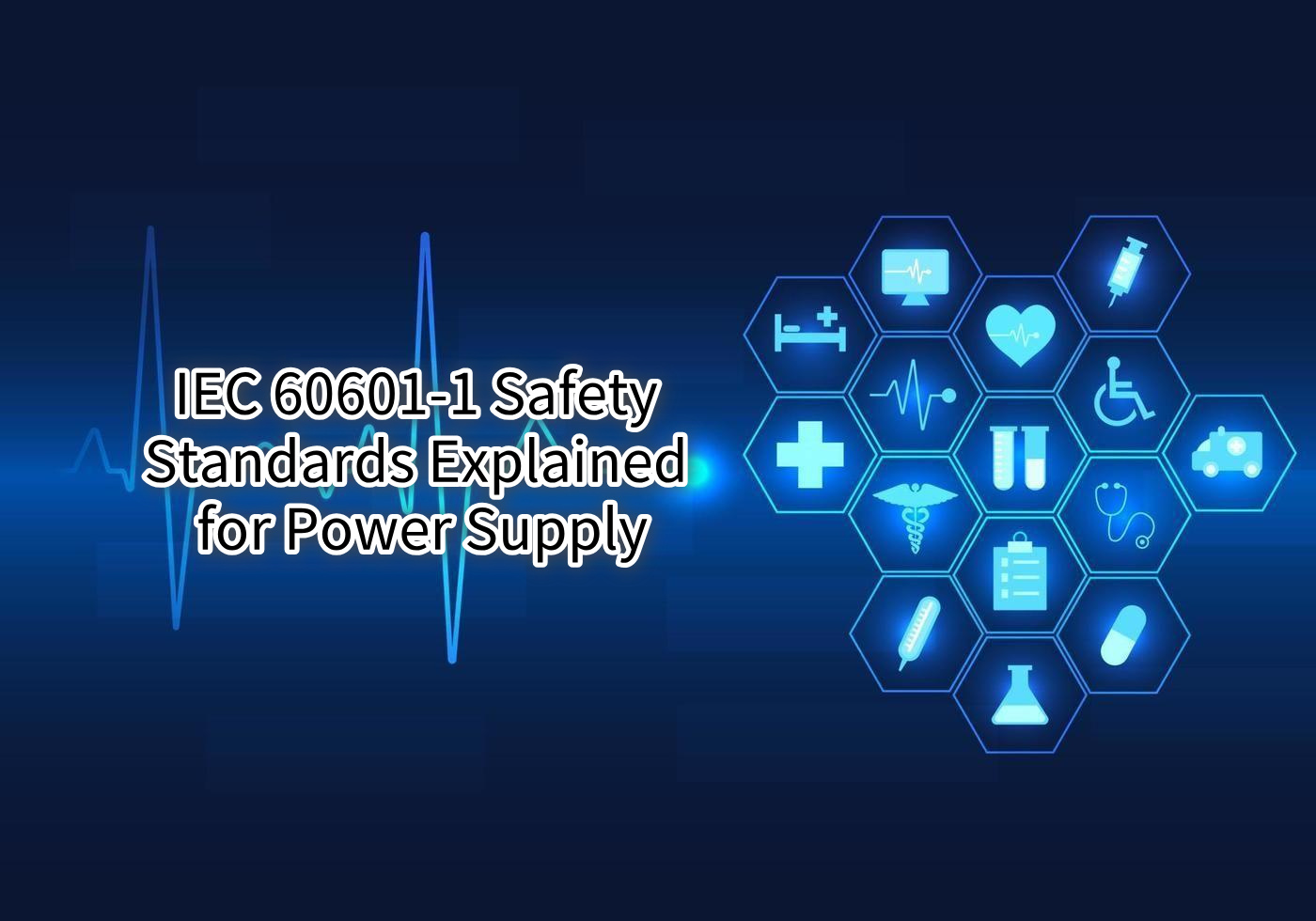
IEC 60601-1 Safety Standards Explained for Power Supply
Excellent and crucial question. IEC 60601-1 is the foundational safety standard for medical electrical equipment, and its requirements for power supplies are far more stringent than those for general-purpose IT or consumer equipment (like IEC 62368-1).
Here’s a detailed explanation of what IEC 60601-1 means for power supplies.
Core Premise: The “Two-Patient” Philosophy
Unlike IT standards that protect users, IEC 60601-1 is designed to protect both the OPERATOR (medical staff) and the PATIENT. The patient is considered particularly vulnerable because they may be:
- Unconscious or sedated.
- Connected directly to the equipment via electrodes, catheters, or sensors that bypass the skin’s natural resistance.
- Dependent on the equipment for life support.
A power supply failure in a medical device could have catastrophic consequences, which is why the standard is exceptionally rigorous.
Key Safety Concepts Critical for Power Supplies
Power supplies in medical devices are engineered to meet three core principles defined in the standard:
- Means of Patient Protection (MOPP): Protection for the patient, where a single fault must not cause a hazardous situation.
- Means of Operator Protection (MOOP): Protection for the operator (less stringent than for the patient, often aligning with IEC 62368-1/60950-1).
- Applied Part: The part of the medical equipment that comes into physical contact with the patient (e.g., ECG lead, blood pressure cuff, ultrasound probe). Requirements vary drastically based on the type of Applied Part:
- Type B (Body): General, not for direct cardiac connection (e.g., hospital bed, phototherapy lamp).
- Type BF (Body Floating): Provides a higher degree of protection through electrical isolation (floating) from earth ground (e.g., ultrasound, blood pressure monitor).
- Type CF (Cardiac Floating): The highest safety grade for direct cardiac connection (e.g., ECG monitors, defibrillators).
The power supply must be designed to provide the required level of isolation (MOPP) for the specific Applied Part (B, BF, or CF).
Critical Technical Requirements for Power Supplies (IEC 60601-1)
1. Enhanced Electrical Isolation (Creepage & Clearance)
This is the most significant differentiator. Distances between primary (hazardous AC mains) and secondary (patient-connected) circuits are much larger than in IT equipment.
- Creepage: Distance along the surface of a PCB.
- Clearance: Distance through the air.
- Example: For 250V working voltage and 2 MOPPs (required for many BF/CF parts), creepage/clearance might be 8mm / 5mm vs. only 3.2mm / 2mm in ITE. This prevents arcing or leakage, especially in humid medical environments.
2. Lower Earth Leakage Current & Patient Leakage Current
This is paramount for patient safety.
- Earth Leakage Current: Stricter limits than ITE (typically ≤ 300µA for permanently connected equipment, vs 3.5mA for ITE).
- Patient Leakage Current: Extremely low limits for Type CF applied parts, often ≤ 10µA under normal conditions and ≤ 50µA under a single fault condition. The power supply’s insulation and filtering must be designed to achieve this.
3. Rigorous Dielectric Strength Test (HIPOT Test)
The isolation barrier must withstand a much higher test voltage to ensure reliability.
- For 2 MOPPs (common for BF/CF), a typical test is 4,000 VAC 또는 1,414 VDC + (2.824 x Working Voltage) for 60 seconds between primary and secondary.
- This is far more severe than the standard 3,000VAC/4,240VDC test for basic insulation in ITE.
4. Defibrillator Protection (for equipment with Type CF/Applied Parts)
The power supply and its applied parts must be designed to withstand the high-energy surge from a defibrillator without damaging the equipment or harming the patient. This involves special transient voltage suppressors and robust isolation.
5. Mechanical & Environmental Requirements
- Enclosures: Must prevent access to hazardous parts, often requiring special tools to open.
- Ingress Protection (IP): May require minimum IP ratings if used in specific environments (e.g., near fluids).
- Temperature & Overload: More conservative limits to prevent overheating in continuous 24/7 operation.
Types of Power Supplies in Medical Devices
- Internal Power Supply: Built into the medical device (e.g., ultrasound machine). Must be fully compliant and certified as part of the whole system.
- External AC/DC Power Adapter (Medical Grade): A separate “wall-plug” or “desktop” unit. Crucially, it must be certified to IEC 60601-1—a standard “IT grade” adapter (IEC 62368-1) is NOT sufficient. Look for the “Medical” marking and its BF or CF rating.
- DC/DC Converters: Used inside equipment to generate different voltages. Must also meet the required MOPP isolation levels.
Certification & Marks
- A medical device must be certified as a complete system. Using a certified medical-grade power supply simplifies but does not replace the final system test.
- Look for certifications from NRTLs (Nationally Recognized Testing Laboratories) like UL (UL 60601-1), TÜV (EN 60601-1), or CSA, which harmonize with IEC 60601-1.
- 그리고 IECEE CB Scheme is vital for global market access, with a CB Report based on IEC 60601-1.
Summary: Key Differences vs. IT/Consumer Power Supplies
| 기능 | IEC 60601-1 (Medical) | IEC 62368-1 (ITE/Consumer) |
|---|---|---|
| Design Philosophy | Protect Patient & Operator | Protect User |
| Isolation (MOPP) | 2 MOPPs typically required | 1 MOOP (Basic Insulation) often sufficient |
| Leakage Current | Extremely low (µA range) | Higher (mA range) acceptable |
| HIPOT Test Voltage | Much higher (e.g., 4kV AC) | Lower (e.g., 3kV AC) |
| Creepage/Clearance | Doubled or more | Standard distances |
| Defibrillator Protection | Required for applied parts | Not required |
| Environmental Testing | More rigorous for clinical use | General office/home use |
In essence, an IEC 60601-1 compliant power supply is an ultra-reliable, ultra-safe component engineered for a zero-failure-tolerance environment. It’s not just a “better” power supply; it’s a fundamentally different product designed to safeguard life where the margin for error is zero.
작성자 정보







댓글 추가