











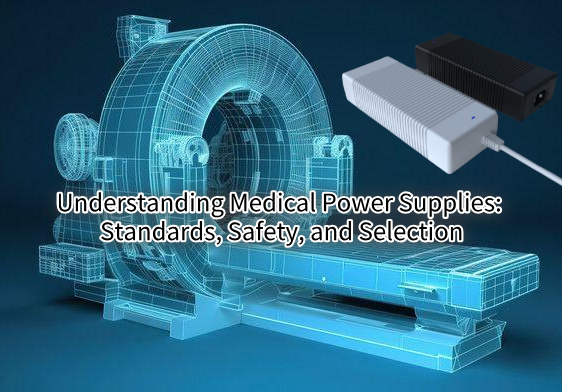
Understanding Medical Power Supplies: Standards, Safety, and Selection
In the world of medical technology, where devices sustain life, diagnose critical conditions, and enable complex surgeries, reliability is non-negotiable. At the heart of this reliability lies a component often overlooked: the medical power supply. Far more than a simple plug-and-play unit, a medical-grade power supply is the guardian of patient and operator safety, engineered to meet the most rigorous global standards.
This article delves into the three pillars that define medical power supplies: the standards they must meet, the safety principles they embody, and the key considerations for selection.
1. The Bedrock: Medical Safety Standards (IEC 60601-1)
The primary differentiator between a commercial and a medical power supply is compliance with the IEC 60601-1 series of standards. This international benchmark sets the requirements for basic safety and essential performance of medical electrical equipment.
Key concepts under this standard include:
- Means of Protection (MOPs): This is the core safety framework. It requires two independent means of protection against electric shock, ensuring that if one fails, the other remains. This is typically achieved through:
- MOPP (Means of Patient Protection): Critical for parts that could contact the patient. Requires higher isolation levels (e.g., 2x MOPP needs 4,000 VAC isolation and 8mm creepage).
- MOOP (Means of Operator Protection): For parts only the operator might touch. Slightly less stringent requirements.
- Low Leakage Current: The amount of electrical current that can “leak” from the power supply to the device chassis and, potentially, to the patient. For patient-connected applications (like ECG monitors), allowable limits are extremely low (often below 100µA) to prevent micro-shocks, especially to the heart.
- Enhanced Insulation and Creepage/Clearance: Physical distances (creepage across a surface, clearance through air) and insulation materials are specified to prevent arcing and breakdown, even in humid environments common in healthcare settings.
- EMI/RFI Mitigation: Medical devices must not interfere with other life-saving equipment. Medical PSUs are designed to minimize electromagnetic and radio-frequency interference, often meeting class B limits.
Other crucial certifications include UL 60601-1 (North America), EN 60601-1 (Europe), and region-specific marks like the CE Mark (with MDD/MDR) and FDA recognition.
2. The Imperative: Safety-by-Design Principles
Safety isn’t just a test result; it’s engineered into every layer of a medical PSU:
- Reliability & Redundancy: Components are derated (operated well below their maximum ratings) for longer lifespan. Critical designs may include redundant circuits.
- Risk Management: Following ISO 14971, manufacturers identify potential hazards (fire, excessive heat, electrical shock) and design mitigations directly into the power supply.
- Fail-Safe Operation: Designs prioritize failure modes that result in a safe, non-operational state rather than a hazardous one.
3. The Process: Selecting the Right Medical Power Supply
Choosing the correct power supply is a strategic decision. Here’s a practical checklist:
- Determine Your Application Class:
- Body Floating (BF) or Cardiac Floating (CF): For devices with patient contact (e.g., ultrasounds, dialysis machines, ECG). Requires the highest safety levels (2x MOPP).
- Body Non-Floating (B-NF): For devices where the patient is not directly connected (e.g., lab analyzers, LED surgical lights). May require only 1x MOPP or MOOPs.
- Define Critical Specifications:
- Input/Output Voltage & Power: Standard AC range (90-264VAC) for global use? Required DC output(s)?
- 効率が良い: Higher efficiency reduces heat, improves reliability, and saves energy.
- Form Factor & Mounting: Open-frame (for integration inside a device), enclosed (standalone), or external desktop/wall-plug?
- Assess Environmental & System Needs:
- Thermal Management: Does your device have good airflow, or will the PSU need to operate in a confined space?
- Ingress Protection (IP Rating): Is the device used in a lab (IP20) or near fluids in an operating room (IP22 or higher)?
- Customization: Do you need specific connectors, cabling, or labeling? Many suppliers offer modified standard designs.
- Plan for Compliance & Lifespan:
- Certification Path: Using a pre-certified medical PSU significantly simplifies and de-risks your own device’s regulatory submission.
- Supplier Partnership: Choose a reputable supplier with a proven track record in medical-grade manufacturing, strong technical support, and a commitment to long-term component availability.
結論
A medical power supply is the silent, vigilant foundation of any healthcare device. Understanding the stringent standards it meets, the depth of its safety engineering, and the careful process required to select it is paramount for any designer, engineer, or procurement specialist in the medical field. By prioritizing a certified, high-quality medical-grade power supply, you invest not just in a component, but in patient safety, device reliability, and the ultimate success of your medical technology.
著者について








コメントを追加