











How to Choose: Regulated or Unregulated Power Supply for Your Project?
Selecting the right power supply is one of the most critical decisions in any electronics project. It’s the foundation upon which all other components rely. The choice between a regulated and an unregulated power supply is often the first and most fundamental step.
This isn’t just a technicality—it’s a decision that impacts your circuit’s performance, reliability, cost, and safety. Choose wrong, and you risk unstable operation, damaged components, or a product that fails in the field.
Let’s break down the key differences and provide a clear framework to guide your choice.
Core Definitions: How They Work
First, understand what you’re comparing.
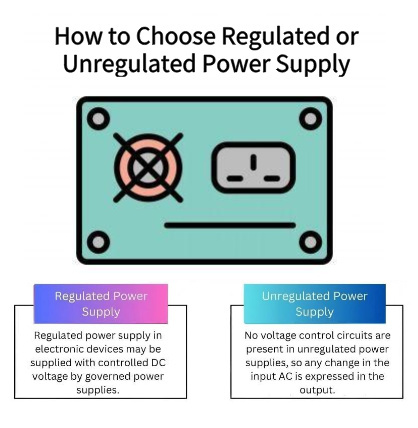
- Unregulated Power Supply: A simple, traditional design. It typically consists of a transformer, rectifier, and filter capacitor. Its output voltage is not held constant—it fluctuates with changes in the input AC line voltage (line regulation) and, more significantly, with the amount of current drawn by the load (load regulation). As load increases, output voltage drops.
- Regulated Power Supply: Incorporates an additional voltage regulation circuit (like a linear regulator or a switching regulator) after the initial rectification and filtering. This circuit actively monitors the output and continuously adjusts to maintain a constant, precise voltage, regardless of reasonable variations in input voltage or output load.
The Decision Matrix: Key Factors to Consider
Ask yourself these four questions to guide your selection.
1. How Stable Does Your Voltage Need to Be?
This is the paramount question.
- Choose REGULATED if: Your project uses digital ICs (microcontrollers, FPGAs, memory), analog sensors, precision amplifiers (op-amps), or any component with a tight voltage tolerance (e.g., 5V ±5%). Fluctuations here can cause crashes, data errors, inaccurate readings, or oscillations.
- Choose UNREGULATED if: You are powering robust loads like resistive heating elements, incandescent lamps, DC motors (with separate drive circuits), or relays. These devices can tolerate, or are unaffected by, moderate voltage swings.
2. How Much Ripple and Noise Can You Tolerate?
- Choose REGULATED if: Your circuit is noise-sensitive. This includes audio equipment, radio receivers (RF circuits), high-gain measurement systems, and communication modules. A good regulated supply, especially a linear regulated type, provides very “clean” DC power.
- Choose UNREGULATED if: Noise is not a concern for the application. Note that an unregulated supply’s output has more “ripple” (residual AC component), which can be problematic for sensitive circuits.
3. What Are Your Efficiency and Thermal Constraints?
- Choose a SWITCHING REGULATED supply if: You need high efficiency, have limited space, and must minimize heat. Ideal for battery-powered devices, high-current applications, or enclosed spaces. (Note: Switching supplies are a type of regulated supply).
- Choose a LINEAR REGULATED supply if: You need very low noise, simplicity, and fast transient response, and can handle lower efficiency. The regulator dissipates excess voltage as heat, requiring heatsinks for higher currents.
- Choose UNREGULATED if: Ultimate simplicity and lowest cost are the drivers, and the efficiency loss from a linear regulator is unacceptable そして a switching regulator’s complexity is overkill.
4. What is Your Budget and Complexity Limit?
- Choose UNREGULATED for: について absolute lowest component cost and simplest design. Perfect for non-critical, high-volume consumer items where every cent counts.
- Choose REGULATED for: Predictable performance and reliability. The added cost of the regulation circuitry is insurance against power-related failures. For most modern electronic projects, this is a necessary expense.
Quick-Reference Comparison Table
| 特徴 | Regulated Power Supply | Unregulated Power Supply |
|---|---|---|
| 出力電圧 | Constant, precise (±1-3% typical) | Varies with load and input line |
| Circuit Complexity | Higher (includes regulator IC/circuit) | Lower (transformer, diode, capacitor) |
| コスト | Higher | より低い |
| Efficiency (Linear vs. Switching) | Linear: Lower (40-60%); Switching: High (70-95%) | Generally high (losses mainly in transformer) |
| 発熱 | Linear: Can be high; Switching: Low | Typically low (no regulator to dissipate heat) |
| Output Ripple/Noise | Very low (Linear); Low (Switching, with filtering) | Higher, varies with load |
| Ideal For | Digital logic, microcontrollers, analog circuits, sensitive sensors | LEDs (non-precision), motors, heaters, relays, battery chargers |
Real-World Application Scenarios
- You’re building a digital thermostat with an MCU and temperature sensor.Choose: Regulated. The microcontroller and sensor require a stable voltage to operate correctly and provide accurate readings. A 5V or 3.3V linear regulator is ideal.
- You need to power a 12V DC cooling fan in an enclosure.Choose: Unregulated. A simple wall adapter (often an unregulated supply) is perfectly adequate. The fan’s speed might vary slightly with voltage, but it will function.
- You’re designing a portable LED worklight.Choose: Regulated (Switching). For battery-powered devices, efficiency is key to maximizing run time. A switching regulator efficiently steps down battery voltage to a constant current for the LEDs.
- You’re creating a variable bench power supply for lab use.Choose: Regulated (Linear for low-noise, Switching for high-power). Stability and clean output are the entire purpose of the tool.
Final Recommendation & Best Practice
For the vast majority of modern electronics projects involving any digital logic or precision analog components, a regulated power supply is non-negotiable. The risk of erratic behavior and damage far outweighs the minor cost savings of an unregulated design.
Best Practice: Even if you choose an unregulated supply for its simplicity or cost, always check the maximum voltage it outputs at light/no load. This “no-load” voltage can be significantly higher than the rated voltage and could exceed the maximum input rating of your components, causing immediate failure. A simple safeguard is to use a “just-in-case” regulator (like a robust 7805) for the sensitive parts of your circuit.
By systematically considering your project’s need for stability, noise tolerance, efficiency, and cost, you can confidently select the power foundation that ensures your design operates as intended—reliably and consistently.
著者について







コメントを追加