











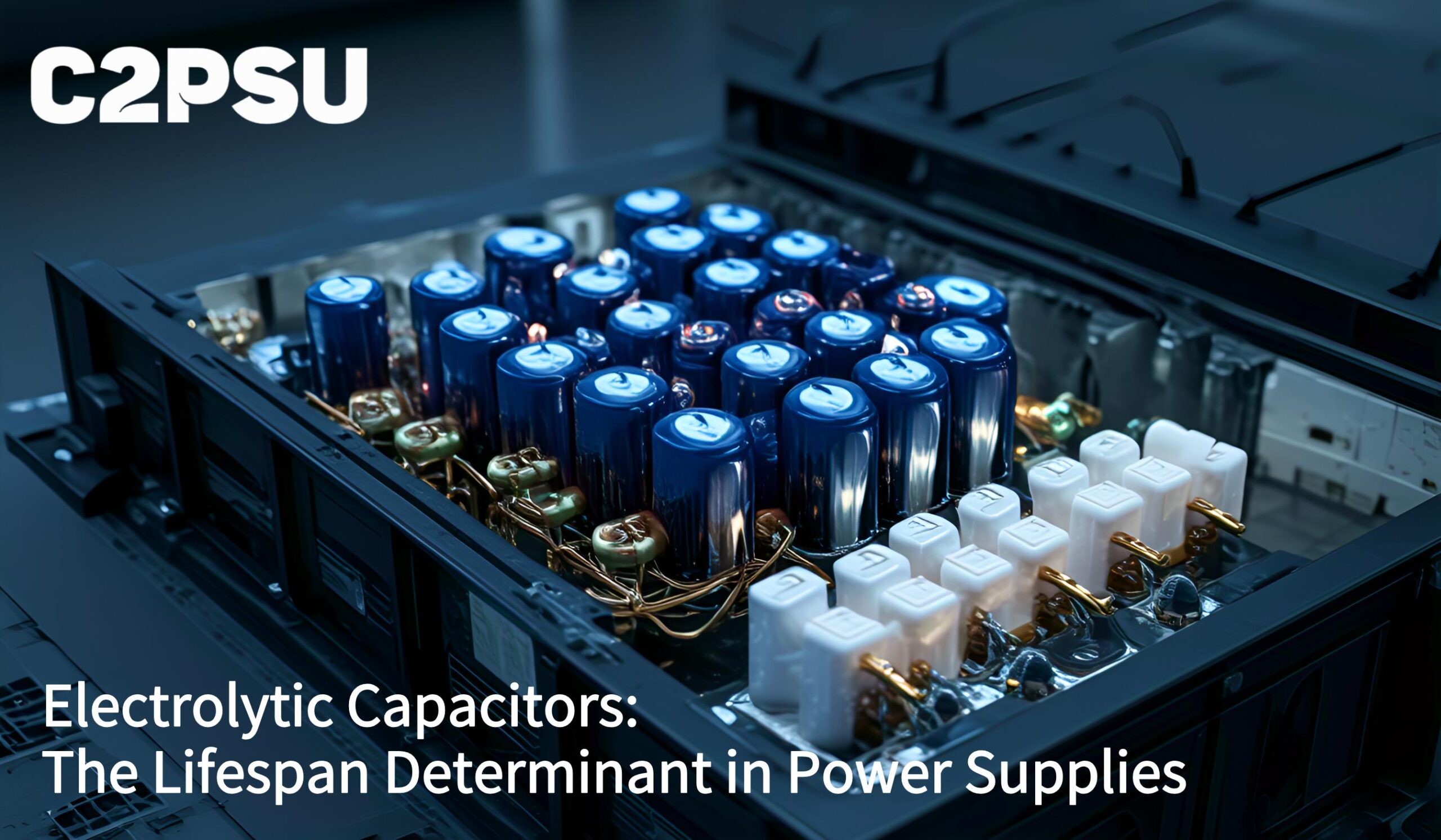
Electrolytic Capacitors: The Lifespan Determinant in Power Supplies
Why Electrolytic Capacitors Are the Weakest Link
In virtually all switched-mode power supplies (SMPS), aluminum electrolytic capacitors (electrolytics) are the primary component that determines the operational lifetime and reliability. While semiconductors, magnetics, and other components can fail, electrolytic capacitors degrade predictably under normal operating conditions, making them the limiting factor for most power supply designs.
The Core Vulnerability: Electrolyte
Unlike other capacitor types, electrolytics contain a liquid or gel electrolyte (typically a borax-based solution) that enables their high capacitance-to-volume ratio. This electrolyte is subject to gradual evaporation through the rubber sealing vent at the top of the can. As the electrolyte dries out, the capacitor loses capacitance and its equivalent series resistance (ESR) increases. This process is accelerated by temperature.
Key Degradation Mechanisms
1. Electrolyte Evaporation (The Primary Killer)
- Process: The internal temperature causes electrolyte to vaporize and slowly diffuse through the seal.
- Result: Capacitance decreases, ESR increases, ripple current handling degrades.
- Governed by Arrhenius Law: For every 10°C rise in core temperature, the chemical reaction rate (and aging) approximately doubles.
2. Electrochemical Reformation
- Process: The aluminum oxide dielectric layer can degrade during idle periods and must reform when voltage is reapplied.
- Result: High leakage current during reforming, potential for catastrophic failure if done too quickly.
- Solution: “Reforming” circuits in some high-end power supplies gently restore the dielectric layer.
3. ESR Increase Over Time
- Process: Chemical changes in the electrolyte and degradation of the internal connections increase resistance.
- Result: Reduced filtering effectiveness, increased internal heating (I²R losses), leading to thermal runaway.
4. End-of-Life Failure Modes
- Graceful Degradation: Capacitance drops below required minimum (typically -20% to -30% from nominal).
- Catastrophic Failure: Pressure buildup from gas generation causes vent to open (loud pop, electrolyte leakage) or, in worst cases, explosion if the vent fails.
The Lifetime Equation: Temperature is Everything
The rated lifetime of an electrolytic capacitor is specified by manufacturers under defined conditions:
Key Specification Example:
- 2,000 hours at 105°C
- 5,000 hours at 105°C
- 10,000 hours at 105°C
This does NOT mean the capacitor will last only 2,000 hours!
Lifetime Calculation Formula:
The actual operating lifetime can be estimated using the Arrhenius-based equation:
Lx = L0 × 2^[(T0 – Tx)/10] × MF
Where:
- Lx = Expected lifetime at operating temperature Tx
- L0 = Rated lifetime at maximum temperature T0 (from datasheet)
- T0 = Maximum rated temperature (e.g., 105°C)
- Tx = Actual core operating temperature
- MF = Multiplying factor for voltage derating (typically 2-4x for 20-30% voltage derating)
Practical Example:
A capacitor rated for 2,000 hours at 105°C operating at:
- 85°C core temperature: Lx = 2,000 × 2^[(105-85)/10] = 2,000 × 2² = 8,000 hours (≈0.9 years)
- 65°C core temperature: Lx = 2,000 × 2^[(105-65)/10] = 2,000 × 2⁴ = 32,000 hours (≈3.7 years)
- 45°C core temperature: Lx = 2,000 × 2^[(105-45)/10] = 2,000 × 2⁶ = 128,000 hours (≈14.6 years)
Critical Insight: Reducing core temperature by 20°C quadruples expected lifetime.
Design Strategies for Maximizing Capacitor Lifespan
1. Temperature Management
- Reduce ambient temperature: Improve system ventilation, avoid heat sources
- Reduce self-heating: Lower ripple current through better circuit design or paralleling capacitors
- Increase physical spacing: Allow for better air circulation
- Consider thermal derating: Operate at 70-80% of rated voltage reduces internal heating
2. Component Selection
- Choose higher temperature rating: 105°C capacitors vs. 85°C versions
- Select low-ESR types: Especially for switching frequency applications
- Consider polymer/long-life series: Some specialized capacitors offer 5,000-10,000 hour base ratings
- Oversize capacitance: Using a higher voltage rating (e.g., 63V instead of 50V) significantly extends life
3. Circuit Design Techniques
- Ripple current sharing: Parallel multiple capacitors to divide ripple current
- Frequency optimization: Higher switching frequencies allow smaller capacitors but may increase ESR heating
- Soft-start circuits: Reduce initial current surges during power-up
- Standby power management: Allow capacitors to cool during idle periods
4. Operational Considerations
- Continuous vs. intermittent operation: Intermittent operation allows cooling periods
- Load profiling: High-load operation should be timed to allow thermal recovery
- Environmental protection: Avoid high humidity, corrosive atmospheres
Failure Symptoms and Field Diagnosis
Early Warning Signs:
- Increased output ripple/ noise – ESR increase reduces filtering
- Audible “singing” or “screeching” – High ESR causing abnormal operation
- Power supply shutdown under load – Inability to deliver required current
- Slow turn-on/startup issues – Reduced capacitance affects soft-start timing
Physical Indicators:
- Bulging/doming of vent – Internal pressure buildup
- Electrolyte leakage – Visible crust or wetness at seal
- ESR measurement – Field testers can detect increased ESR before capacitance drops significantly
Alternatives and Future Trends
1. Solid Polymer Capacitors
- No liquid electrolyte (dry polymer)
- Much lower ESR, higher ripple current capability
- Longer lifetime (typically 50,000+ hours at 105°C)
- Higher cost, limited voltage ratings (typically ≤100V)
2. Hybrid Capacitors
- Combine liquid electrolyte with polymer materials
- Balance of lifetime, ESR, and cost
- Growing popularity in mid-range power supplies
3. Ceramic Capacitors (MLCCs)
- No wear-out mechanism from electrolyte evaporation
- Used in parallel with electrolytics for high-frequency decoupling
- Limited to lower capacitance values for bulk storage
4. Tantalum Capacitors
- Solid electrolyte, no drying out
- Good for filtering but with different failure modes
- Higher cost and sensitivity to surge currents
Practical Design Recommendations
- Calculate worst-case temperatures using thermal modeling, not just ambient assumptions
- Derate aggressively: Operate at ≤70% of rated voltage and ≤75% of rated ripple current
- Use lifetime prediction tools provided by capacitor manufacturers
- Design for maintainability: Place capacitors in accessible locations for replacement
- Implement health monitoring in critical applications (ESR measurement circuits)
Conclusion: Balancing Cost and Reliability
The choice of electrolytic capacitors represents a fundamental cost-reliability trade-off in power supply design:
- Consumer electronics: May use 2,000-hour capacitors with minimal derating
- Industrial/telecom: Typically specify 5,000-10,000 hour capacitors with significant derating
- Medical/military: May avoid electrolytics entirely or use only polymer/hybrid types
The capacitor’s core temperature is the single most important design parameter for power supply longevity. A well-designed thermal management system that keeps electrolytic capacitors cool will typically outlast all other components in the power supply, turning the traditional “weakest link” into a reliable, long-lasting component.
Note on L10 vs. B10 Life: Capacitor lifetime ratings typically represent the point at which 10% of units would have failed (L10 life), not average life. For critical applications, designers should use more conservative calculations or select capacitors with longer base ratings.

著者について







コメントを追加