
Nessun prodotto nel carrello.











Understanding Different Types of Power Supplies and Their Applications
Imagine plugging your laptop into a wall outlet. The outlet provides Alternating Current (AC), but your laptop needs Direct Current (DC) to run. The humble power supply is the unsung hero that bridges this gap, silently converting and regulating power for virtually every electronic device we use.
But not all power supplies are created equal. Choosing the wrong type can lead to inefficiency, device damage, or even failure. This guide will demystify the different types of power supplies and their key applications, helping you make an informed choice for any project or device.
1. By Form Factor & Location
This classification is about where the power supply is located in relation to the device it powers.
A. Internal Power Supply Unit (PSU)
- What it is: A built-in unit housed inside the device’s main enclosure.
- Key Characteristics: Connects directly to the device’s motherboard and components. Designed for specific form factors (e.g., ATX for desktops).
- Primary Applications:
- Desktop Computers (ATX, SFX, TFX PSUs)
- Servers and Workstations
- Large Consumer Electronics (e.g., home audio receivers, some TVs)
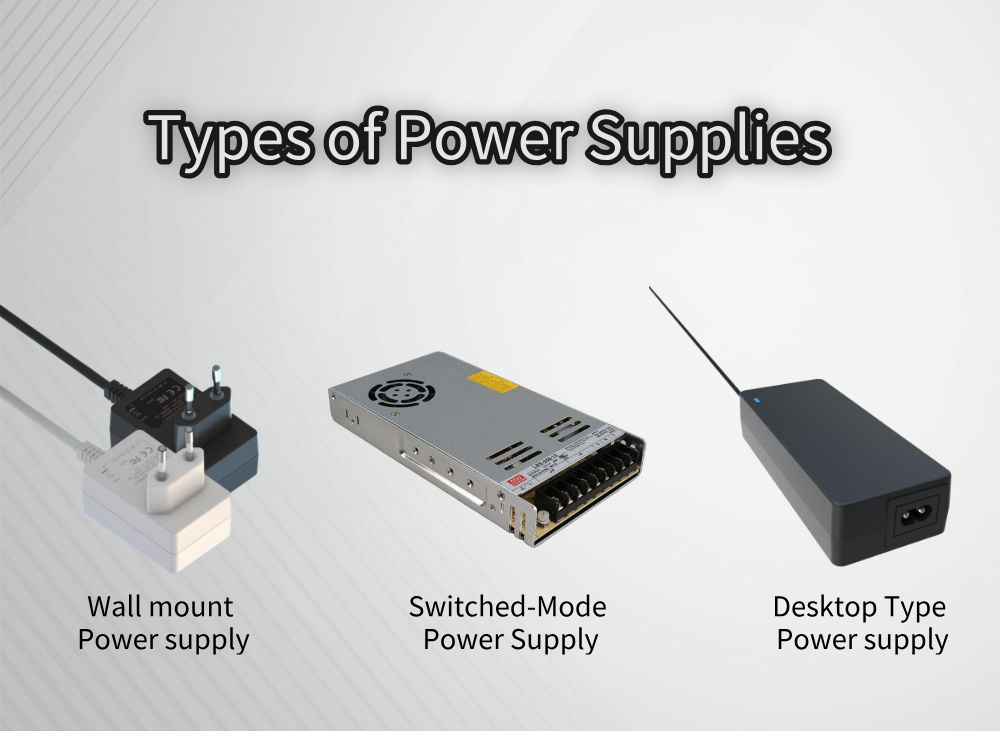
B. External Power Supply (Power Adapter/”Wall Wart”)
- What it is: A separate unit that plugs into a wall outlet, converting AC to DC, which is then delivered via a cable.
- Key Characteristics: Moves heat and bulk away from the device, simplifying design and reducing device size. Often includes interchangeable plugs for global use.
- Primary Applications:
- Laptops and Notebooks
- Monitors
- Small Consumer Electronics (routers, modems, game consoles, USB hubs)
- IoT Devices and Smart Home Gadgets
C. Embedded Power Supply
- What it is: A set of power conversion components (like a small PCB) directly integrated into the main circuitry of a device.
- Key Characteristics: Highly compact and customized for a specific device’s voltage/current needs. Not user-replaceable.
- Primary Applications:
- Smartphones and Tablets
- Modern Flat-Screen TVs
- Appliances and Industrial Control Boards
2. By Conversion Method & Technology
This is the most critical technical classification, defining how the power supply converts and regulates electricity.
A. Linear Power Supply
- How it works: Uses a transformer to step down AC voltage, then rectifies it to DC, and finally uses a linear regulator to “burn off” excess voltage as heat to achieve a clean, stable output.
- Pros: Simple design, very low electrical noise (ripple), fast transient response.
- Cons: Inefficient (especially with large voltage differences), bulky, heavy, and generates significant heat.
- Applications: Audio amplifiers (where noise is critical), laboratory bench power supplies, sensitive analog measurement equipment, vintage electronics.
B. Switched-Mode Power Supply (SMPS)
- How it works: The modern standard. Converts AC to high-frequency AC using a switching transistor, steps it down with a small ferrite transformer, rectifies it to DC, and then finely regulates the output. This high-frequency switching allows for high efficiency.
- Pros: Highly efficient (often >80-90%), compact, lightweight, and runs cooler for the same power output.
- Cons: More complex design, can produce high-frequency electrical noise (EMI) that needs filtering.
- Applications: Ubiquitous. Desktop computers, consumer electronics, LED lighting, industrial machinery, telecommunications equipment.
C. Uninterruptible Power Supply (UPS)
- How it works: A system that provides backup power when the main input fails. It consists of a battery, an inverter (to convert battery DC to AC), and a charging circuit. Types include Standby, Line-Interactive, and Online/Double-Conversion.
- Pros: Provides protection against power outages, surges, and sags.
- Cons: Additional cost, requires battery maintenance/replacement.
- Applications: Protecting computers and servers, critical network infrastructure, medical equipment, cash registers, and home office setups.
Choosing the Right Power Supply: A Quick Guide
Use this checklist to narrow down your options:
- Input Voltage: What are you plugging it into? (e.g., 120V AC, 240V AC, 12V DC in a car?)
- Output Requirements:
- Voltage (V): Must match your device exactly (e.g., 5V, 12V, 19V).
- Current/Amperage (A): The power supply’s rated current must be equal to or greater than the device’s requirement.
- Connector Polarity: Ensure the tip/plug is positive/negative (+/-) as required.
- Efficiency & Noise: Need ultra-clean power for audio/analog? Consider a linear supply. Need high efficiency and small size for most digital gadgets? SMPS is the answer.
- Form Factor: Is it built into a PC (Internal ATX)? Is it for a laptop (External Adapter)? For critical systems, do you need a UPS?
- Safety & Certification: Always look for safety marks (UL, CE, TÜV, etc.) to ensure the unit is properly designed and will not be a fire or shock hazard.
Conclusion
From the tiny charging circuit in your wireless earbuds to the massive, redundant PSUs in a data center, power supplies are the foundational link between the raw power grid and the delicate electronics that define our world. Understanding the core types—Linear for precision, Switched-Mode for efficiency, Uninterruptible for protection, and the various form factors—empowers you to choose wisely, ensure compatibility, and guarantee the safe and reliable operation of any electronic device.
Need Help? When in doubt, always refer to your device’s manual for its specific voltage, current, and polarity requirements. Choosing a quality, correctly specified power supply is an investment in the longevity and performance of your valuable electronics.
About author

Related posts

Choosing the right voltage for your power supply is a critical decision that affects performance, safety, and longevity of your electronic systems. While it may... Continua a leggere
Power isn’t just an afterthought for your robot—it’s its lifeblood. Selecting the correct battery charger and power cord is one of the most critical, yet... Continua a leggere
A high-performance CPU, a powerful GPU, fast storage—these are the components that capture our attention when building or upgrading a system. Yet, the component that... Continua a leggere
In the vast landscape of industrial automation, we often celebrate the “brains” of the operation—the controllers and computers that make decisions. However, the true “muscle”... Continua a leggere
If you’ve ever wondered what keeps modern factories running smoothly, the answer is simple: Programmable Logic Controllers (PLCs) . These rugged industrial computers have been the foundation... Continua a leggere




Add comment