
Nessun prodotto nel carrello.











IEC Protection Classes for Power Supplies: A Guide to Safety and Design
When selecting or designing a power supply, electrical safety is paramount. The International Electrotechnical Commission (IEC) has established a system of protection classes (often called equipment classes) that define how a device is protected against electric shock. These classes are fundamental to understanding the safety construction of power supplies and the equipment they power.
The Three Main Protection Classes
The IEC system categorizes electrical equipment into Class I, Class II, and Class III, based on their method of protection against electric shock.
Class I: Grounded Protection
This is the most common class for industrial and desktop power supplies.
- Key Feature: Relies on a protective earth (ground) connection.
- Construction:
- Has basic insulation between live parts and accessible conductive parts (like the metal enclosure).
- All accessible conductive parts are connected to a grounding terminal via a protective earth (PE) wire (the green/yellow wire in the mains cable).
- Safety Principle: If a fault occurs (e.g., basic insulation fails and a live part touches the metal case), the current is safely diverted to earth through the ground wire. This causes a high fault current that should quickly trip the circuit breaker or fuse, disconnecting the supply and making the enclosure safe.
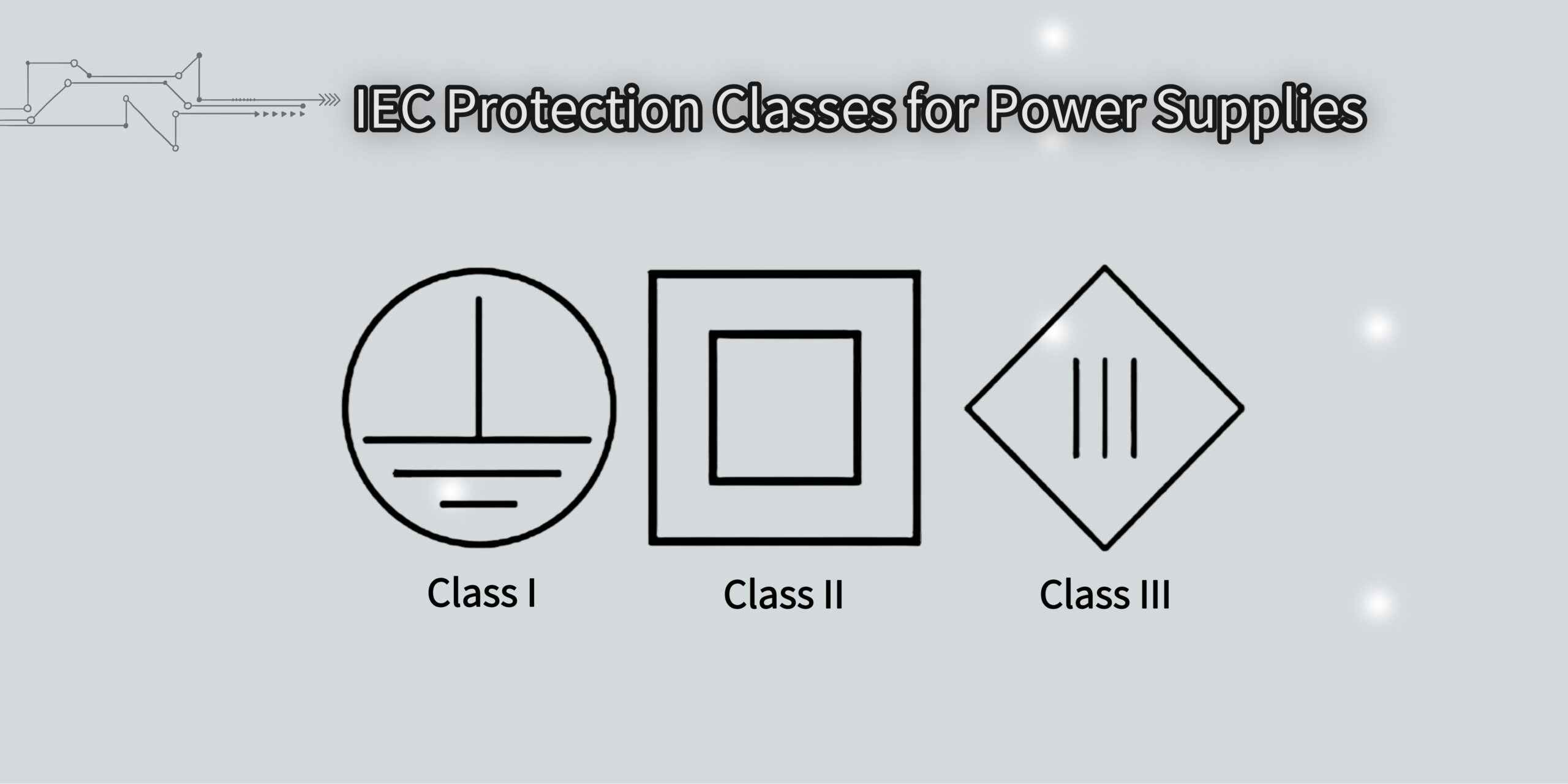
- Identification: Il three-pin plug (Live, Neutral, Earth). The symbol on the rating plate is: ⏚ (earth symbol in a circle).
- Application: Desktop PCs, industrial equipment, appliances with metal enclosures like washing machines, and many linear bench power supplies.
Class II: Double or Reinforced Insulation
Commonly known as “double-insulated” and often used in consumer electronics.
- Key Feature: Does not rely on a protective earth ground. Protection is achieved through insulation alone.
- Construction:
- Double Insulation: Comprises basic insulation plus an additional, separate layer of supplementary insulation.
- Reinforced Insulation: A single insulation system that provides a level of protection equivalent to double insulation (tested to higher voltages).
- Safety Principle: Even if the basic insulation fails, a second, independent barrier prevents contact with live parts. There is no need for a grounding connection.
- Identification: Two-pin plug (Live & Neutral only). The official symbol on the rating plate is: (a square inside a square).
- Application: Phone/ laptop chargers (external “wall warts”), power tools, hair dryers, desk lamps, and many modern switch-mode power supplies (SMPS) for consumer electronics.
Class III: Safety Extra-Low Voltage (SELV)
Protection through the use of very low, non-hazardous voltage.
- Key Feature: Operates at a Safety Extra-Low Voltage (SELV) level where contact with live parts presents no risk of electric shock under normal or single-fault conditions.
- Voltage Limits: Typically ≤ 25V AC RMS or ≤ 60V DC (IEC 60950-1, IEC 62368-1 standards).
- Power Source: Must be supplied by a Class II (or equivalent safety isolated) power source or a safety transformer. There is no direct connection to the mains.
- Safety Principle: The voltage is intrinsically safe and does not require protective earth or double insulation on the Class III device itself.
- Application: Battery-powered devices (where the battery is the SELV source), low-voltage LED lighting systems, toys, and the output side of well-isolated AC/DC adapters. The adapter itself is usually Class II, providing a safe SELV output for the Class III device.
Comparison Table
| Feature | Class I | Class II | Class III |
|---|---|---|---|
| Protection Method | Basic Insulation + Grounding | Double/Reinforced Insulation | Low, Safe Voltage (SELV/PELV) |
| Earth Wire Required? | Yes (Essential for safety) | No | No (for the device itself) |
| Mains Plug | 3-pin (L, N, PE) | 2-pin (L, N) | Not applicable (low-voltage input) |
| Enclosure | Usually conductive (metal) | Non-conductive (plastic) or insulated conductive | Any |
| Key Safety Reliance | Earth connection & overcurrent protection | Integrity of insulation layers | Voltage level & isolation of source |
| Typical Symbol | ⏚ | | Often marked “SELV” |
Important Related Concepts
- IP Rating (Ingress Protection): Do not confuse with Class. IP ratings (e.g., IP67) define protection against solids (dust) and liquids (water). A device can be Class I and IP67.
- Class 0 (Obsolete): An outdated, unsafe class with only basic insulation and no grounding. Not permitted in most modern standards.
- Class III vs. PELV: PELV (Protective Extra-Low Voltage) is similar to SELV but may have a functional connection to earth. SELV is more strictly isolated.
Why It Matters for Power Supplies
- Selection: You must choose a power supply with the correct class for your application and end-product safety certification.
- Installation: Class I devices must be connected to a properly grounded outlet. Using a 3-to-2 pin adapter defeats the safety mechanism and is hazardous.
- Design & Compliance: Designing a Class II power supply is more challenging (strict creepage/clearance distances, reinforced isolation barriers) but eliminates the need for a ground wire in the end product.
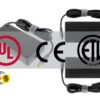
- Global Markets: These IEC classes form the basis of safety regulations worldwide (e.g., UL, CE marking). Compliance is mandatory for market access.
Practical Example:
A LED desk lamp might use a Class II external power adapter (a “wall wart” with a 2-pin plug). The adapter provides a SELV (Class III) output (e.g., 12V DC) to the lamp. The lamp’s internal wiring, operating at this safe voltage, does not require further insulation for shock protection.
Conclusion
Understanding IEC protection classes is non-negotiable for anyone working with electrical power. Class I grounds the danger, Class II insulates from it, and Class III operates at a voltage too low to be dangerous. Always check the class symbol and wiring requirements of a power supply to ensure it is used safely and in accordance with its design and regulatory certification.

About author

Related posts

Choosing the right voltage for your power supply is a critical decision that affects performance, safety, and longevity of your electronic systems. While it may... Continua a leggere
Power isn’t just an afterthought for your robot—it’s its lifeblood. Selecting the correct battery charger and power cord is one of the most critical, yet... Continua a leggere
A high-performance CPU, a powerful GPU, fast storage—these are the components that capture our attention when building or upgrading a system. Yet, the component that... Continua a leggere
In the vast landscape of industrial automation, we often celebrate the “brains” of the operation—the controllers and computers that make decisions. However, the true “muscle”... Continua a leggere
If you’ve ever wondered what keeps modern factories running smoothly, the answer is simple: Programmable Logic Controllers (PLCs) . These rugged industrial computers have been the foundation... Continua a leggere


Add comment