
Aucun produit dans le panier.











How to Convert Volts to Amps
Introduction to Electrical Conversion
Understanding the relationship between volts, amps, and ohms is fundamental to working with electrical circuits. This guide will help you master volts to amps conversion using Ohm’s Law and provide you with practical tools for your calculations.
Ohm’s Law: The Foundation
Ohm’s Law states the fundamental relationship between voltage (V), current (I), and resistance (R):
V = I × R
Where:
- V = Voltage in volts (V)
- I = Current in amperes (A)
- R = Resistance in ohms (Ω)
How to Calculate Amps from Volts
Basic Formula
To find current (amps) when you know voltage and resistance:
I = V / R
Example Calculation:
If you have a 12V battery connected to a 4Ω resistor:
I = 12V / 4Ω = 3A
When You Know Power (Watts)
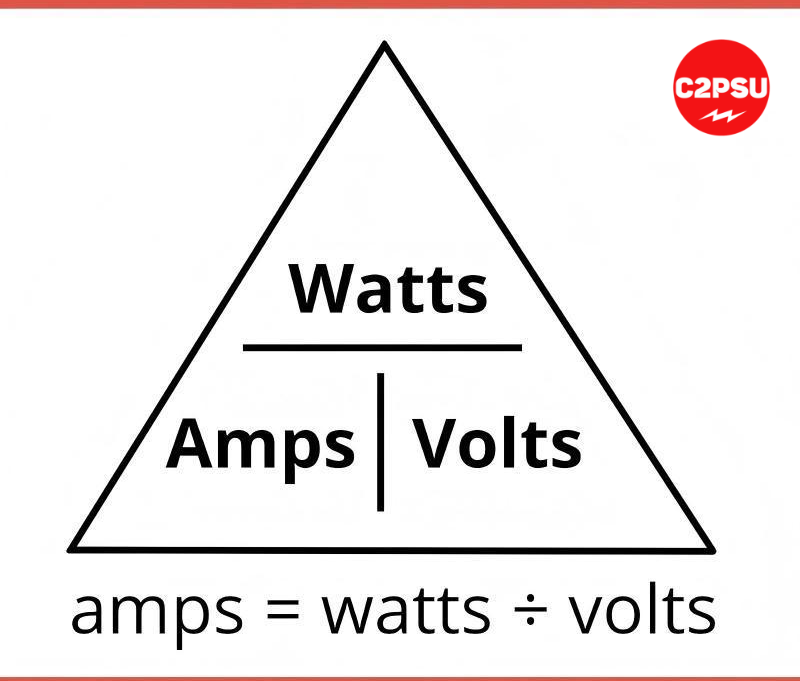
If you know voltage and power but not resistance, use the power formula:
P = V × I
Therefore:
I = P / V
Example Calculation:
A 60W light bulb operating at 120V:
I = 60W / 120V = 0.5A
Interactive Conversion Tool
Below is a simplified representation of how an interactive calculator would function. For actual calculations, use the formulas provided or check our website for the live calculator.
Volts to Amps Calculator
Method 1: Using Resistance
Enter Voltage (V): [   12   ] V
Enter Resistance (Ω): [   4    ] Ω
─────────────────────────────────
Current = 12V ÷ 4Ω = 3.00 Amps
Method 2: Using Power
Enter Voltage (V): [   120   ] V
Enter Power (W): [   60    ] W
─────────────────────────────────
Current = 60W ÷ 120V = 0.50 Amps
Common Conversion Scenarios
1. Household Applications
- Standard US Outlet: 120V, 15A circuit = 1800W maximum
- European Outlet: 230V, 10A circuit = 2300W maximum
- USB Charger: 5V, 2.4A = 12W power delivery
2. Automotive Applications
- Car Battery: 12V system
- Headlight: 12V, 5A = 60W bulb
- Starter Motor: 12V, 200A = 2400W during cranking
3. Electronics
- LED Strip: 12V, 1.5A per meter = 18W/m
- Computer Power Supply: Various voltages (3.3V, 5V, 12V) with different current ratings
Quick Reference Conversion Table
| Voltage (V) | Resistance (Ω) | Current (A) | Power (W) |
|---|---|---|---|
| 1.5 | 10 | 0.15 | 0.23 |
| 5 | 50 | 0.10 | 0.50 |
| 12 | 6 | 2.00 | 24.00 |
| 24 | 12 | 2.00 | 48.00 |
| 120 | 60 | 2.00 | 240.00 |
| 230 | 115 | 2.00 | 460.00 |
Important Considerations
AC vs. DC Current
- DC (Direct Current): Simple calculation using Ohm’s Law
- AC (Alternating Current): Must consider power factor for accurate calculationstext复制下载I = P / (V × PF)Where PF is power factor (typically 0.8-0.9 for many devices)
Safety Factors
- Circuit Protection: Always size circuit breakers/fuses appropriately
- Wire Gauge: Higher current requires thicker wires to prevent overheating
- Voltage Drop: Over long distances, voltage drop affects actual current
- Efficiency Losses: Converters and transformers have efficiency ratings affecting calculations
Practical Examples with Step-by-Step Solutions
Example 1: Simple Resistor Circuit
Problème: Calculate current through a 100Ω resistor with 9V battery.
Step 1: I = V / R
Step 2: I = 9V / 100Ω
Step 3: I = 0.09A or 90mA
Example 2: Appliance Power Consumption
Problème: A 1500W space heater runs on 120V. What current does it draw?
Step 1: I = P / V
Step 2: I = 1500W / 120V
Step 3: I = 12.5A
Safety Check: This exceeds a standard 10A outlet limit in some countries!
Example 3: Parallel Circuit Calculation
Problème: Two devices in parallel: Device A = 12V, 2A; Device B = 12V, 3A. Total current?
Step 1: In parallel circuits, voltage is the same
Step 2: I_total = I_A + I_B
Step 3: I_total = 2A + 3A = 5A
Advanced Applications
Three-Phase Power Systems
For three-phase systems, the calculation differs:
I = P / (√3 × V × PF)
Where:
- √3 ≈ 1.732 (square root of 3)
- V = line-to-line voltage
- PF = power factor
Battery Runtime Calculation
Runtime (hours) = Battery Capacity (Ah) / Current Draw (A)
Example: A 100Ah battery powering a 5A device:
Runtime = 100Ah / 5A = 20 hours
Troubleshooting Common Issues
Problem: Calculator Gives Unexpected Results
Possible Causes:
- Units mismatch: Ensure all values in correct units (V, A, Ω, W)
- AC vs. DC confusion: Remember power factor for AC calculations
- Circuit configuration: Series vs. parallel affects calculations
- Measurement errors: Verify meter accuracy and calibration
Problem: Real-World Current Differs from Calculated
Consider These Factors:
- Temperature effects: Resistance changes with temperature
- Component tolerances: Real components have ±5% to ±20% tolerances
- Voltage fluctuations: Mains voltage varies (typically ±10%)
- Efficiency losses: No system is 100% efficient
Conversion Formulas Cheat Sheet
Basic Formulas:
I = V ÷ R                 (Amps = Volts ÷ Ohms)
I = P ÷ V                 (Amps = Watts ÷ Volts)
V = I × R                 (Volts = Amps × Ohms)
P = V × I                 (Watts = Volts × Amps)
R = V ÷ I                 (Ohms = Volts ÷ Amps)

AC Power (with Power Factor):
I = P ÷ (V × PF)          (Amps = Watts ÷ (Volts × Power Factor))

Three-Phase Power:
I = P ÷ (1.732 × V × PF)  (Amps = Watts ÷ (1.732 × Volts × Power Factor))
Mobile-Friendly Quick Calculator
For quick mental calculations, remember these common conversions:
- 120V Systems: Divide watts by 120 to get amps
- 230V Systems: Divide watts by 230 to get amps
- 12V Systems: Divide watts by 12 to get amps
- Quick Estimate: For 120V, 1A ≈ 120W; For 230V, 1A ≈ 230W
Conclusion
Mastering volts to amps conversion is essential for anyone working with electrical systems. Whether you’re sizing circuit breakers, selecting wire gauges, or designing electronic circuits, understanding these relationships ensures safety, efficiency, and proper system operation.
Key Takeaways:
- Always start with Ohm’s Law (V = I × R)
- Consider whether you’re working with AC or DC systems
- Account for power factor in AC calculations
- Remember safety margins in practical applications
- Use the appropriate formula for your specific scenario
For complex calculations or critical applications, always consult with a qualified electrical professional and verify calculations with actual measurements.
Note: This information is for educational purposes. Always follow local electrical codes and consult professionals for critical applications. Actual calculations may vary based on specific conditions, component tolerances, and environmental factors.


A propos de l'auteur

Postes connexes

Choosing the right voltage for your power supply is a critical decision that affects performance, safety, and longevity of your electronic systems. While it may... Poursuivre la lecture

Power isn’t just an afterthought for your robot—it’s its lifeblood. Selecting the correct battery charger and power cord is one of the most critical, yet... Poursuivre la lecture

A high-performance CPU, a powerful GPU, fast storage—these are the components that capture our attention when building or upgrading a system. Yet, the component that... Poursuivre la lecture

In the vast landscape of industrial automation, we often celebrate the “brains” of the operation—the controllers and computers that make decisions. However, the true “muscle”... Poursuivre la lecture

If you’ve ever wondered what keeps modern factories running smoothly, the answer is simple: Programmable Logic Controllers (PLCs) . These rugged industrial computers have been the foundation... Poursuivre la lecture








Ajouter un commentaire