
No hay productos en la cesta.











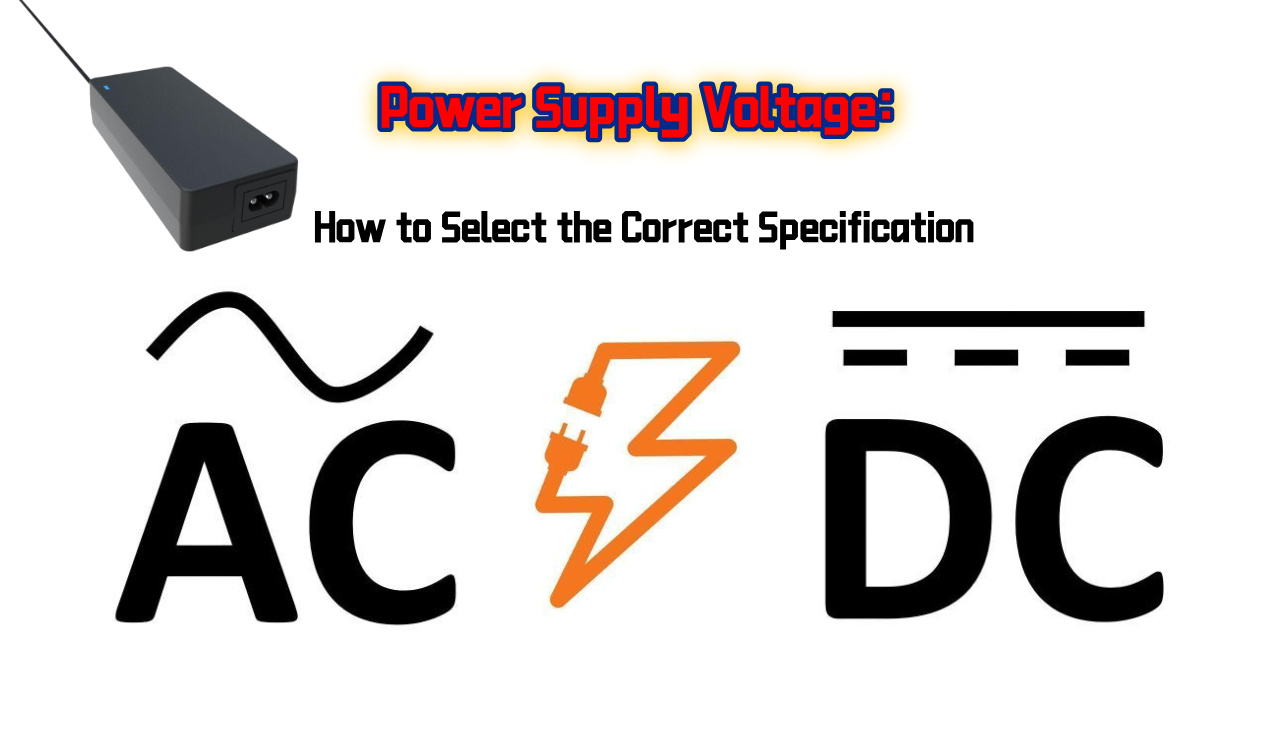
Power Supply Voltage: How to Select the Correct Specification
Choosing the right voltage for your power supply is a critical decision that affects performance, safety, and longevity of your electronic systems. While it may seem like a simple matching game, several nuanced factors determine the optimal voltage specification for your application.
Understanding Voltage Fundamentals
Power supply voltage refers to the electrical potential difference provided to a load, typically measured in volts (V). In DC power supplies, this is the steady output voltage—such as 5V, 12V, 24V, or 48V—that powers your equipment.
Step 1: Start with Your Load Requirements
Check Device Specifications
The first and most crucial step is identifying your load’s exact voltage requirements:
- Nameplate/Data Sheet Review
- Locate the “Input Voltage,” “DC Input,” or “Power Requirements” section
- Note both nominal voltage (e.g., 24V DC) and acceptable range (e.g., 18-30V DC)
- Identify if the device requires regulated or unregulated power
- Voltage Type Verification
- DC vs. AC: Confirm which type your device needs
- Polarity: Note positive/negative terminal requirements
- Special Requirements: Some devices need negative voltages or dual supplies (±12V, ±15V)
Step 2: Understand Voltage Tolerances and Regulation
The 80% Rule vs. Exact Matching
A common misconception suggests power supplies should be rated 20-30% higher than the nominal load voltage. This applies to current capacity (amperage), not voltage.
For voltage: Match the nominal requirement exactly.
- If your device requires 24V DC, select a 24V DC power supply
- The power supply’s current rating should exceed your device’s requirement by 20-30%
- Example: A 2A device should be powered by at least a 2.4A (preferably 3A) power supply at 24V
Considering Voltage Drop
In applications with long cable runs between power supply and load, voltage drop becomes significant:
Voltage Drop = 2 × Cable Length × Current × Wire Resistance
Practical solution: Select a power supply with voltage adjustment capability or choose a slightly higher nominal voltage to compensate for expected drop.
Step 3: Account for Real-World Conditions
Temperature Effects
Power supply output voltage can vary with temperature:
- Semiconductor characteristics change with temperature
- Efficiency drops at temperature extremes
- Derating may be necessary in high-temperature environments
Check the manufacturer’s temperature coefficient specification (typically expressed as %/°C or mV/°C).
Load Variations
Consider how your load behaves:
- Constant loads (sensors, logic circuits): Require stable voltage
- Variable loads (motors, solenoids): Cause voltage fluctuations
- Pulsed loads (transmitters, actuators): Create transient demands
For variable or pulsed loads, select a power supply with excellent load regulation (typically <1% for quality units).
Step 4: Select the Appropriate Voltage Class
Common DC Voltage Classes and Applications
| Voltage | Primary Applications | Key Considerations |
|---|---|---|
| 3.3V | Microcontrollers, FPGAs, modern digital ICs | Tight regulation required (±5% typical) |
| 5V | Legacy digital logic, USB devices, Arduino | Very common, many options available |
| 12V | PC peripherals, automotive, LED lighting | Good balance of efficiency and safety |
| 24V | Industrial controls, PLCs, actuators, robotics | Industry standard for control systems |
| 48V | Telecom, PoE, server racks, higher power systems | More efficient for power transmission |
Safety Voltage Classes
- SELV (Safety Extra Low Voltage): ≤ 60V DC – No significant shock hazard
- PELV (Protected Extra Low Voltage): Similar to SELV with additional protective earthing
- For user-accessible equipment, SELV-rated supplies are often specified
Step 5: Consider Power Supply Characteristics
Regulation Quality
- Line regulation: How well output maintains stability with input variations
- Load regulation: How well output maintains stability with load changes
- Ripple and noise: High-frequency variations superimposed on DC output
Adjustability Requirements
Some applications benefit from adjustable power supplies:
- Prototyping and testing
- Systems requiring fine-tuning
- Applications with varying requirements
Step 6: Special Application Considerations
Battery Charging Applications
When charging batteries:
- Match voltage to battery chemistry requirements
- Lead-acid: 2.4V per cell (14.4V for 12V battery)
- Li-ion: 4.2V per cell (varies by chemistry)
- Consider temperature compensation for optimal charging
LED Lighting Applications
For constant-current LED drivers:
- Ensure power supply voltage exceeds LED string voltage
- Include headroom for proper current regulation
- Account for forward voltage drop variation with temperature
Industrial Control Systems
- 24V DC is industry standard for sensors and PLCs
- Consider redundancy for critical systems
- Include appropriate circuit protection
Step 7: Practical Selection Workflow
Use this checklist when specifying power supply voltage:
- Device Requirements
- Nominal voltage: _____ V
- Acceptable range: _____ to _____ V
- Current requirement: _____ A
- Special needs (negative, dual, etc.): _____
- Application Factors
- Cable length: _____ meters/feet
- Expected voltage drop: _____ V
- Operating temperature range: _____ to _____ °C
- Load type (constant/variable/pulsed): _____
- Power Supply Specifications
- Output voltage matches nominal requirement: _____ V
- Current capacity exceeds need by 20-30%: _____ A
- Regulation meets application needs: < _____ %
- Ripple/noise acceptable for application: < _____ mVpp
- Safety and Compliance
- SELV/PELV if required
- Appropriate safety certifications (UL, CE, etc.)
- Environmental ratings match installation location
Common Mistakes to Avoid
Mistake 1: Oversizing Voltage “Just to Be Safe”
Consequence: Can damage voltage-sensitive components
Solution: Match nominal voltage exactly; oversize current capacity instead
Mistake 2: Ignoring Cable Losses
Consequence: Undervoltage at load, poor performance
Solution: Calculate voltage drop or use remote sensing capability
Mistake 3: Assuming All 12V Supplies Are Equal
Consequence: Intermittent problems, premature failures
Solution: Check regulation specs, not just nominal voltage
Mistake 4: Neglecting Temperature Effects
Consequence: Voltage drift, out-of-spec operation
Solution: Review temperature coefficients and derating curves
When to Consult a Specialist
Consider professional assistance when:
- Designing mission-critical or safety systems
- Working with unusual voltage requirements
- Combining multiple loads with different needs
- Operating in extreme environments
- Needing custom solutions
Conclusion: Precision Matters
Selecting the correct power supply voltage specification requires attention to detail beyond simple nominal matching. By understanding your load’s true requirements, accounting for application conditions, and specifying appropriate power supply characteristics, you ensure reliable, efficient, and safe operation.
Remember: Voltage must match precisely; current capacity provides the headroom. When in doubt, consult device documentation, calculate worst-case scenarios, and when possible, test under actual operating conditions before finalizing your selection.
Ready to specify your power supply? Start with your load’s exact requirements, consider the complete application environment, and choose a quality power supply from a reputable manufacturer with appropriate specifications for your needs.

Sobre el autor

Puestos relacionados
Power isn’t just an afterthought for your robot—it’s its lifeblood. Selecting the correct battery charger and power cord is one of the most critical, yet... Seguir leyendo
A high-performance CPU, a powerful GPU, fast storage—these are the components that capture our attention when building or upgrading a system. Yet, the component that... Seguir leyendo
In the vast landscape of industrial automation, we often celebrate the “brains” of the operation—the controllers and computers that make decisions. However, the true “muscle”... Seguir leyendo

If you’ve ever wondered what keeps modern factories running smoothly, the answer is simple: Programmable Logic Controllers (PLCs) . These rugged industrial computers have been the foundation... Seguir leyendo

High-voltage (HV) power supplies are the workhorses behind critical applications like medical imaging (X-ray, CT scanners), semiconductor manufacturing, scientific instrumentation, and industrial processing. While much... Seguir leyendo




Añadir un comentario